Satin vs. Silk Bonnets for Type 4 Coils: Friction Coefficients, Moisture Regain & Overnight Preservation
Every night, the average human changes sleeping positions between 20 and 40 times. For delicate 4A, 4B, and 4C coily strands, those nocturnal micro-movements generate thousands of mechanical shear events against your pillow. While both satin and silk headwear shield curls from cotton friction, their underlying fiber physics, moisture absorption kinetics, and breathability profiles couldn't be more different.
Core Material Science Takeaways
- 1. Friction Reduction Benchmark: Pure 22-momme mulberry silk exhibits a friction coefficient (COF) of ~0.24 against keratin, reducing mechanical shear stress by over 60% compared to standard cotton bedding.
- 2. Moisture Regain Equilibrium: Natural silk possesses an 11% moisture regain, harmonizing with hair proteins without wicking away plant oils; synthetic polyester satin has <1% moisture regain, locking in oil but trapping perspiration.
- 3. Knots & Trichorrhexis Nodosa: Sleeping on rough fabrics forces interlocking coils to tangle into single-strand knots (fairy knots) that inevitably snap during morning detangling.
- 4. Band Construction Dictates Edge Retention: Narrow, tight elastic bands produce continuous nocturnal traction on temporal follicles. Edge preservation demands wide, flat, fabric-encased bands.
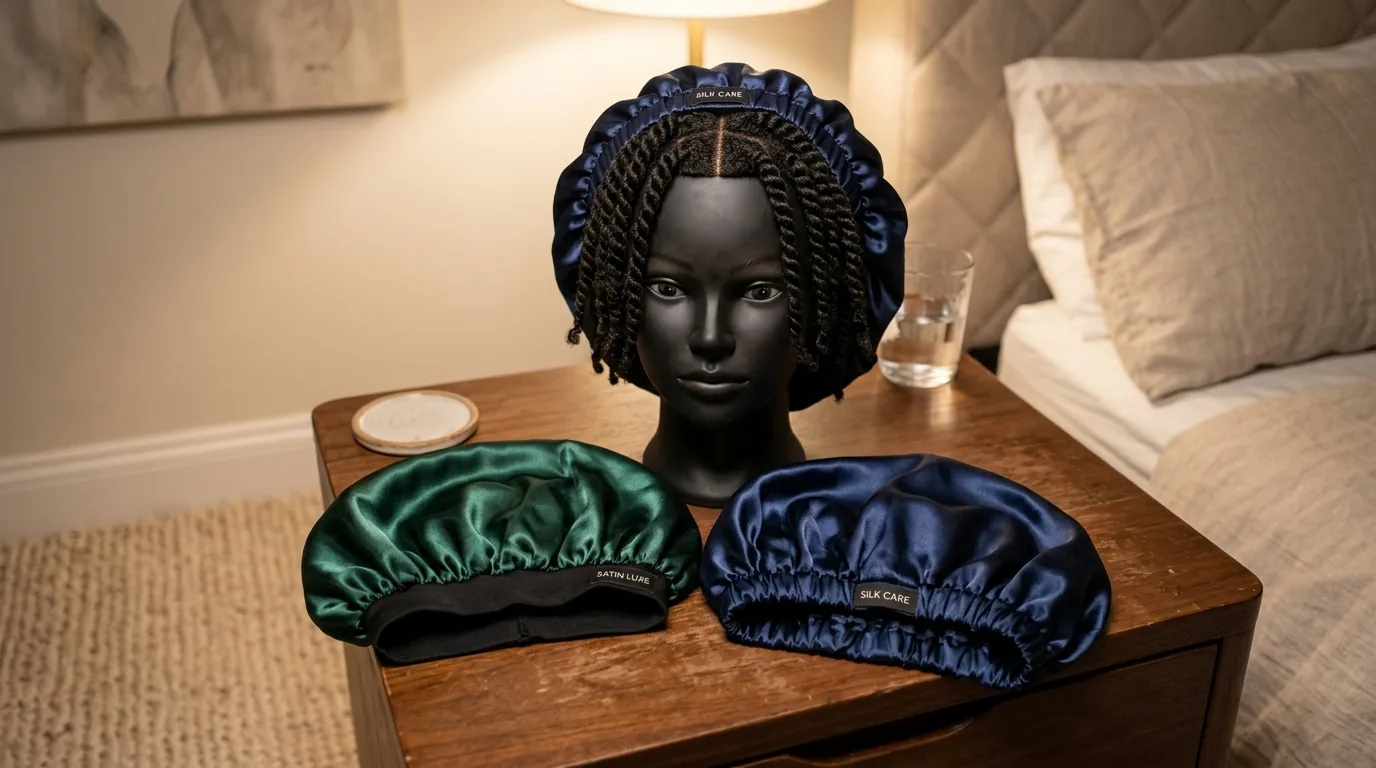
1. Material Science: Fibroin Protein Silk vs. Woven Polyester Satin
The most frequent misconception encountered at our beauty supply counter is the belief that "satin" and "silk" are interchangeable terms. They represent entirely different textile categories:
Mulberry Silk (The Biomimetic Protein)
Silk is a continuous filament protein fiber secreted by the domesticated Bombyx mori silkworm. Its structural core is composed of fibroin, a crystalline protein rich in glycine, alanine, and serine, surrounded by an organic glycoprotein coating called sericin. Under microscopy, silk filaments exhibit a triangular prism geometry, giving the fiber its natural luster and an ultra-smooth glide that mirrors the keratin cuticles of human hair.
Polyester Satin (The Synthetic Float Weave)
Satin is not a raw material; it is a specific weaving pattern where four or more warp threads float over a single weft thread. In commercial bonnets, satin is almost universally woven from synthetic polyethylene terephthalate (polyester) or polyamide (nylon) filaments. While the weave creates a sleek, glossy surface face, the back side of single-layer satin remains rough, dull, and abrasive.
2. The Biophysics of Nocturnal Friction: Eliminating Fairy Knots
Why does sleeping unprotected on a standard cotton pillowcase cause catastrophic breakage for Type 4 hair?
Coefficient of Friction (COF) Dynamics
The coefficient of friction represents the resistance encountered when two surfaces slide against one another. In laboratory tribology testing:
- Cotton Percale / Sateen: COF ~0.60 to 0.65 against hair keratin. Cotton fibers feature rough, twisted cellulosic cell walls that grip hair cuticle scales like microscopic sandpaper.
- Commercial Polyester Satin: COF ~0.28 to 0.33 when dry. The synthetic float weave provides significant friction reduction compared to cotton.
- 22-Momme Mulberry Silk: COF ~0.22 to 0.26. The triangular fibroin filaments provide the lowest surface roughness of any known textile, allowing coils to glide effortlessly without catching.
Preventing Single-Strand Knots (SSKs)
Type 4 strands have an elliptical cross-section and intense helical recoil. When subjected to the high shear friction of cotton bedding, neighboring strands are forced to twist around each other, creating single-strand knots (trichorrhexis nodosa). When detangled the next morning, combs snag on these knots, snapping the hair shaft. Both silk and high-grade satin eliminate sleep-induced shear, reducing knot formation by over 80%. Review our core retention rules in The Moisture Retention Handbook for Type 4 Hair.
3. Moisture Physics & Hygroscopy: Why Fabric Choice Dictates Hydration
The most critical divergence between silk and satin lies in their hygroscopic behavior—how they interact with water vapor and botanical oils:
| Textile Material | Moisture Regain Rate | Oil Absorption | Scalp Breathability | Thermal Regulation |
|---|---|---|---|---|
| Pure Mulberry Silk | ~11.0% (Equilibrium) | Low (Preserves lipids) | Excellent (Vapor permeable) | Thermo-regulating (Cool) |
| Polyester Satin | < 0.8% (Hydrophobic) | Zero (Repels all lipids) | Poor (Micro-greenhouse) | Traps heat / sweat |
| Standard Cotton | Up to 27x weight in water | Extremely High (Wicks oils) | Moderate | Absorbs night sweat |
Because cotton absorbs up to 27 times its weight in water, resting your head on a cotton pillowcase literally leeches leave-in conditioners and plant lipids out of your cuticle layers overnight.
However, synthetic polyester satin presents the opposite problem: with a moisture regain under 1%, it cannot breathe. In warm climates like South Florida, polyester traps body heat and sweat against the scalp, creating an occlusive greenhouse that exacerbates microbial folliculitis and causes styling gel reversion. Mulberry silk strikes the perfect biological balance: its 11% moisture regain buffers humidity without drying the hair shaft. For porosity management, see Low Porosity vs. High Porosity Cuticle Science.
4. Bonnet Engineering: Why Band Design Can Destroy Your Hairline
Even the most expensive 22-momme silk bonnet can cause severe damage if its physical construction is poorly engineered:
Inexpensive commercial bonnets utilize a thin (0.25-inch) exposed rubber elastic band gathered with bunched ruffles. Throughout 8 hours of sleep, this narrow elastic digs into the temporal bones and frontal hairline, concentrating shear stress on the delicate perimeter follicles. Over months, this continuous nocturnal tension leads to traction alopecia along the edges.
Professional-grade bonnets feature a wide (1.5 to 2.5-inch), flat, silk- or satin-encased compression band or adjustable ribbon ties. This distributes pressure evenly across the forehead and occiput without pinching, eliminating friction marks and protecting baby hairs. For more on protecting fragile styles, explore Protective Styling Longevity & Scalp Integrity.
Single-layer satin bonnets present their smooth side outward while the dull, rough underside rubs directly against your hair coils all night. Always choose double-layered, reversible bonnets where the ultra-smooth float weave faces inward against your hair and outward against your bedding.
5. The Stylist's Buyer Guide: How to Select Your Ideal Headwear
Use this decision hierarchy when shopping for nocturnal protective headwear at Kayla's Beauty Supply:
The Headwear Selection Hierarchy
- • Tier 1 (The Gold Standard): 100% Mulberry Silk Bonnet (19 to 22 Momme). Best for individuals with sensitive or itchy scalps, hot sleepers, high-porosity dry hair, or chemically treated coils requiring maximum breathability and zero lipid stripping.
- • Tier 2 (The Reliable Budget Protector): Double-Layered Charmeuse Polyester Satin with Wide Flat Band. An excellent, cost-effective option for protective braids, twists, or locs. Ensure the bonnet is roomy enough to prevent compressing volume.
- • Tier 3 (The Backup Security): 100% Silk Pillowcase. Perfect for individuals whose bonnets slip off during the night. If your headwear comes off, your hair glides safely against silk rather than abrasive cotton sheets.
Frequently Asked Questions: Satin & Silk Bonnets
Is satin a fabric fiber or a weaving technique?
Satin is a weaving technique characterized by floating warp threads across four or more weft threads, creating a glossy, smooth surface. It can be woven from any yarn, but commercially it is almost always made from synthetic petroleum-derived polyester or nylon filaments. In contrast, silk is an all-natural animal protein fiber produced by Bombyx mori silkworms.
Does a cotton pillowcase really damage Type 4 hair overnight?
Yes. Cotton has a high coefficient of friction (COF ~0.65) compared to silk (COF ~0.24). As you toss and turn during sleep, cotton abrades the cuticle scales, causing microscopic fractures and forming single-strand knots (fairy knots). Furthermore, cotton is highly hygroscopic, wicking natural sebum and moisturizing creams straight out of your hair.
Why can polyester satin bonnets cause an itchy or sweaty scalp?
Polyester is hydrophobic with a moisture regain of less than 1%, meaning it cannot absorb or breathe away vapor. When worn overnight, dense synthetic satin creates an occlusive micro-greenhouse over the skull, trapping body heat and perspiration against the scalp. This promotes Malassezia yeast overgrowth and exacerbates itchy seborrheic dermatitis.
What type of bonnet elastic prevents hairline traction damage?
Avoid bonnets with thin, pinching, exposed rubberized elastic cords, which focus mechanical shear stress directly onto fragile temporal follicles. Instead, select bonnets equipped with wide (1.5 to 2 inches), flat, silk- or satin-encased compression bands or adjustable tie ribbons that distribute holding pressure evenly across the forehead and occipital bone.