The Moisture Retention Handbook for Type 4 Coily & Kinky Hair: Biophysics, Cuticles & Sealing
Why does 4C hair feel soft and hydrated on Sunday morning, only to turn brittle, rough, and prone to breakage by Tuesday afternoon? The solution lies not in piling on heavier greases, but in mastering the biophysical mechanics of moisture absorption, cuticle curvature, and lipid barrier sealing.
Core Principles of Type 4 Moisture Retention
- 1. True Hydration Is Water (H₂O): Oils and butters do not moisturize hair; they are occlusive barriers. Moisture is purely hydrogen-bonded water molecules captured within the keratin cortex.
- 2. The Sebum Migration Deficit: The tight helical coiling of Type 4 hair physically blocks scalp sebum from reaching the shaft, leaving mid-lengths and ends exposed to rapid environmental dehydration.
- 3. Porosity Dictates Delivery: Low-porosity cuticles require heat and alkalinity to accept moisture; high-porosity cuticles require acidic rinses and heavy polymers to lock it in.
- 4. Layering Thermodynamics: Successful sealing requires applying low-molecular-weight penetrate oils (Coconut, Jojoba) before macromolecular occlusives (Shea Butter, Castor Oil).
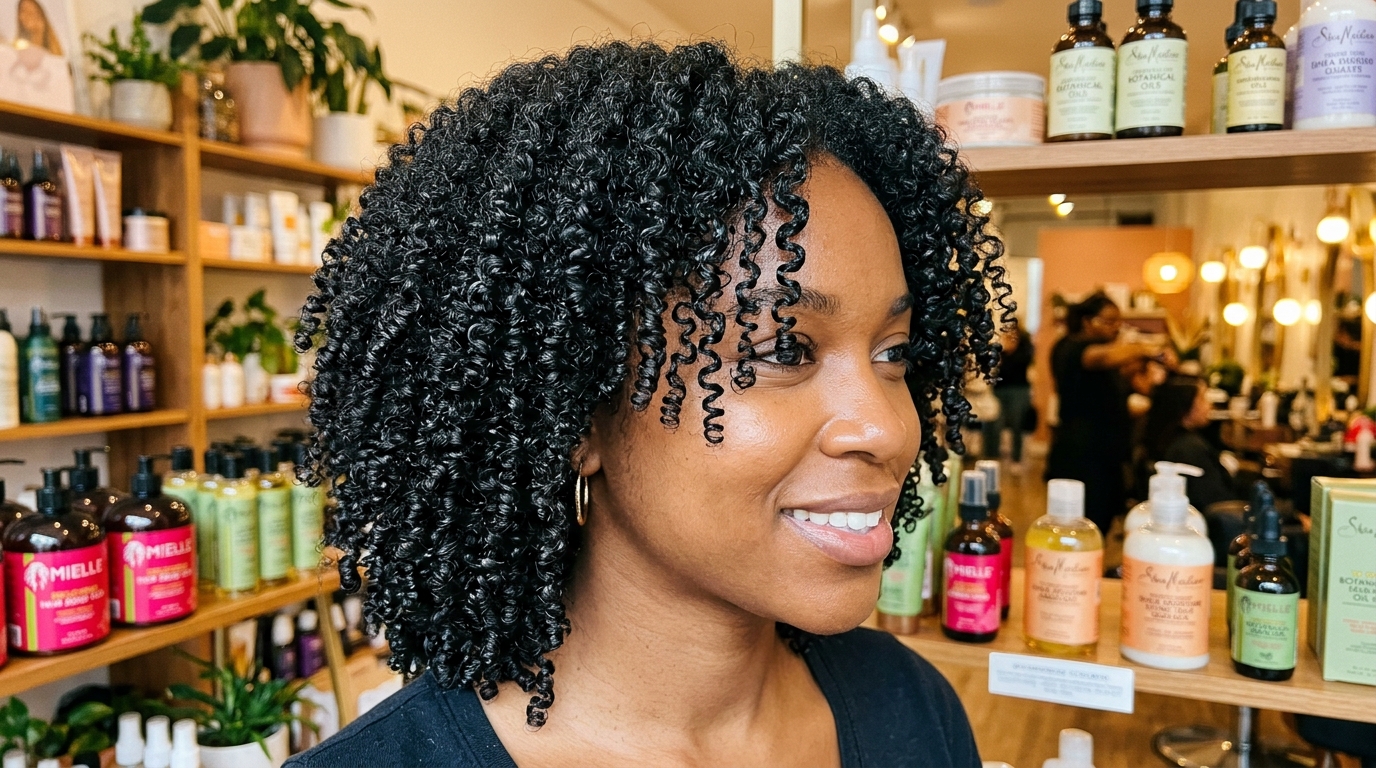
1. The Biophysics of Type 4 Hair: Elliptical Geometry & Breakage Points
To understand why Afro-textured hair requires an entirely different moisturizing regimen than straight or wavy hair, one must inspect hair anatomy under scanning electron microscopy. Straight hair (Type 1) has a perfectly circular cross-section, with a uniform, multi-layered cuticle sheath that lies flat.
In contrast, Type 4 hair (4A, 4B, 4C) exhibits an asymmetrical, flat-elliptical or kidney-shaped cross-section. The hair shaft does not grow in a uniform cylinder; instead, it twists and turns with sharp, acute helical curves.
The Sebum Impedance Problem
Sebaceous glands at the follicle base secrete natural sebum composed of squalene, triglycerides, and wax esters. While straight hair allows sebum to effortlessly glide down the strand, the acute twists, kinks, and sharp angles of Type 4 coils create physical roadblocks. Sebum pools on the scalp while the ends remain starved of natural lipids.
Cuticle Lift Vulnerability
Every single turn, kink, and spiral along a 4C strand represents a point of mechanical tension where cuticle scales flare outward rather than lying flush. These lifted cuticle junctions allow cortex water molecules to evaporate rapidly into the ambient air, leaving the hair dry and brittle within 24 to 48 hours.
To diagnose your specific cuticle structure, review our companion clinical guide: Low Porosity vs. High Porosity: Cuticle Science & Slip Tests.
2. The 4-Phase Hydration Cascade: Water, Humectant, Emollient & Occlusive
Most failed regimens occur because products are applied in an illogical order. Achieving 5-to-7 day hydration requires executing the following 4-phase cascade:
You cannot moisturize dirty hair. Heavy silicones, styling waxes, and edge control gels form an impermeable barrier that blocks water. Begin with a chelating, clarifying shampoo to clear product residues. Then, saturate strands with warm water (38°C–40°C) to gently swell cuticles and fill the cortex.
Apply a water-based leave-in conditioner formulated with small-molecule humectants. Glycerin and Panthenol possess low molecular weights that penetrate between keratin microfibrils, forming hydrogen bonds with water molecules and preventing rapid evaporation.
Layer a conditioning cream containing Cetyl Alcohol, Stearyl Alcohol, and unrefined Jojoba or Babassu oil. Fatty alcohols smooth the rough edges of flared cuticles, imparting immediate slip and eliminating inter-fiber friction. For complete ingredient sequencing, explore LOC vs. LGO: Penetration Chemistry.
The final step is the physical vapor lock. High-molecular-weight plant butters and viscous triglycerides form a water-resistant film over the cuticle layer. This prevents ambient air from leeching moisture out of the cortex, locking in hydration for up to 7 full days.
3. The Formulator's Ingredient Matrix: Penetrating vs. Sealing Lipids
Not all oils behave the same on textured hair. Some possess triglycerides small enough to enter the cortex, while others reside exclusively on the surface:
| Lipid / Ingredient | Primary Fatty Acid Chain | Penetration Capacity | Function | Ideal For |
|---|---|---|---|---|
| Virgin Coconut Oil | Lauric Acid (C12:0) | Deep Cortex Penetration | Reduces protein loss, reinforces core | High porosity / chemically treated |
| Golden Jojoba Oil | Gadoleic / Erucic Waxes | Partial Cuticle Penetration | Mimics human sebum, balances scalp | All porosities / sensitive scalps |
| Sweet Almond Oil | Oleic Acid (C18:1) | Moderate Intercellular | Enhances elasticity, softens stiffness | Medium & low porosity coils |
| Raw Shea Butter (Nilotica) | Stearic / Oleic Triglycerides | Zero (Surface Occlusive) | Vapor barrier, seals ends, smooths | Dry 4C ends, high porosity coils |
| Jamaican Black Castor Oil | Ricinoleic Acid (C18:1-OH) | Zero (Heavy Occlusive) | Maximum water-trapping, edge security | Thick coarse coils & protective styles |
Formulation data verified via hair fiber spectrometry and the Journal of Cosmetic Science studies on lipid absorption kinetics.
4. The Protein-Moisture Equilibrium: Avoiding Hygral Fatigue
A common trap in the natural hair community is over-moisturizing. Constant saturation with water and heavy wet leave-ins without structural protein causes hygral fatigue—the repeated swelling and contracting of the hair cuticle until the protein bonds weaken and hair feels mushy, gummy, and limp.
Conversely, excessive protein treatments make hair stiff, hard, and snap under minimal tension. Learn how to diagnose elasticity using the wet-stretch test in our deep dive on Protein-Moisture Balance: Hygral Fatigue vs. Protein Overload.
5. The 7-Day Salon Moisture & Length Retention Protocol
Follow this weekly master schedule created by Kayla's Beauty Supply master stylists:
- Day 1 (Wash & Deep Hydration Day): Clarify, deep condition under warm hooded dryer for 20 minutes, rinse with cool water to close cuticles, and apply the LOC/LGO layering sequence while hair is 80% damp.
- Days 2 to 3 (Low Manipulation Styling): Install chunky twists or wear hair in loose, low-friction updos. Do not re-wet hair; the occlusive seal remains active.
- Day 4 (Mid-Week Refresh): Mist lightly with a water and aloe vera spritz (90% distilled water, 10% aloe juice) to reactivate humectants. Smooth 2 drops of jojoba oil over ends.
- Days 5 to 6 (Night Preservation): Sleep strictly under a dual-layer satin bonnet or silk scarf. Cotton pillowcases act like giant sponges, wicking 40% of hair lipids away overnight.
- Day 7 (Pre-Wash Assessment): Examine ends for single-strand knots (fairy knots) or dryness before preparing for the next wash cycle. When protective braiding is desired, review our definitive manual on Protective Styling Longevity & Scalp Integrity.
Frequently Asked Questions: Type 4 Hair Moisture
Why does Type 4 hair dry out so much faster than loose curl types?
Type 4 hair possesses an elliptical, ribbon-like cross-section with sharp bends and kinks along the hair shaft. These acute curves prevent natural scalp sebum (squalene, wax esters, triglycerides) from migrating down the strand to lubricate and seal the cuticles. Additionally, each bend creates mechanical points of vulnerability where cuticle scales lift, accelerating internal moisture evaporation into ambient dry air.
How do you keep 4C natural hair moisturized for more than 2 days?
Sustained hydration requires a four-phase protocol: clarify mineral and wax buildup with a gentle sulfate-free cleanser, infuse warm water to swell the cortex, apply a low-molecular-weight humectant and fatty alcohol leave-in conditioner, and seal with a heavy lipid occlusive (such as raw shea butter, castor oil, or cupuaçu butter) to physically trap moisture before it evaporates.
What is the best routine to retain length with tight coils?
Length retention is achieved by eliminating mechanical friction and brittle snapping. Key elements include low-manipulation styling (twists, flat twists, tension-safe braids), sleeping on 100% pure 22-momme mulberry silk or satin bonnets, keeping ends tucked and sealed, and balancing protein treatments every 6 to 8 weeks to prevent hygral fatigue.