Low Porosity vs. High Porosity: Cuticle Science & The Tactile Slip Test
Porosity is the single most critical biological metric determining how hair interacts with water, conditioners, and oils. Understanding whether your cuticles are impenetrable shingles or damaged gates transforms daily styling from frustrating breakage into predictable length retention.
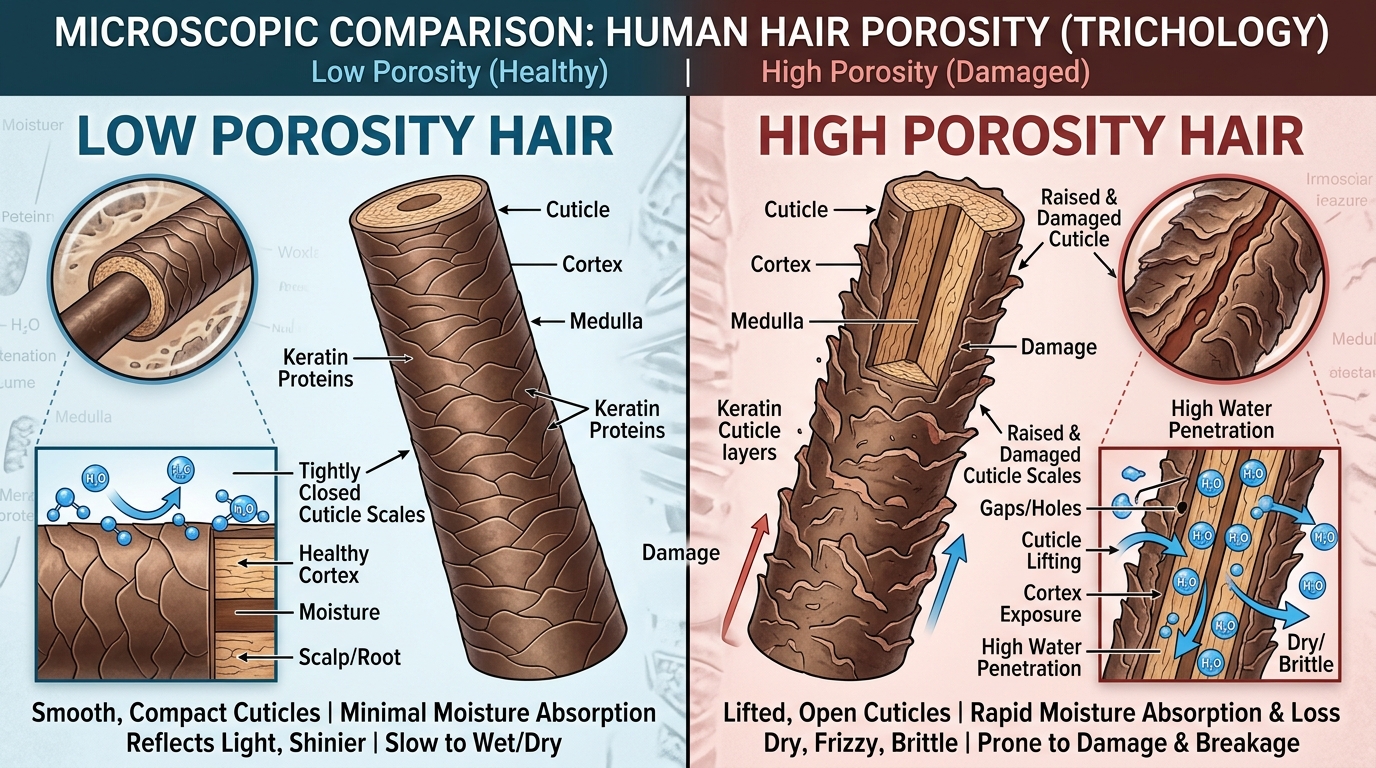
1. Cuticle Anatomy: The Shingles of the Hair Shaft
The outermost protective sheath of a human hair fiber is the cuticle layer, composed of 6 to 10 overlapping scales of flattened, keratinized cells cemented together by the 18-methyleicosanoic acid (18-MEA) lipid matrix.
Hair porosity refers to the ability of the hair fiber to absorb and retain moisture, which is governed strictly by the structural alignment and spacing of these cuticle scales:
Low-Porosity Cuticle Physics
Cuticle scales lie flat, tight, and seamless like slate roof shingles. Water droplets bead up on the surface and roll off. Products sit on top of the strand rather than absorbing. However, once moisture successfully penetrates the cortex, it remains trapped for days because the cuticles tightly close behind it.
High-Porosity Cuticle Physics
Cuticle scales are raised, chipped, or missing entirely due to chemical bleaching, relaxers, mechanical friction, or thermal damage. Water instantly rushes into the open spongy cortex. However, because there are no intact cuticle scales to seal the exit, moisture evaporates just as rapidly, leaving strands chronically dry and fragile.
Review the foundational biophysics of tight coil moisture retention in The Moisture Retention Handbook for Type 4 Hair.
2. Why the Viral "Water Glass Float Test" Is Scientifically Flawed
For over a decade, social media hair influencers have instructed consumers to drop a shed hair strand into a glass of water: if it floats, it's low porosity; if it sinks, it's high porosity. As cosmetic chemists and licensed master stylists, we urge clients to abandon this test immediately.
The water glass test fails basic fluid physics for two undeniable reasons:
- Surface Tension & Sebum Hydrophobicity: Even severely damaged high-porosity hair is naturally coated with a microscopic film of hydrophobic sebum and hair products. Water's high surface tension prevents the strand from breaking the meniscus, causing high-porosity hair to float falsely.
- Air Pockets in Kinky Coils: The helical geometry of 4C coils traps tiny micro-pockets of air within the curl bends, creating buoyancy that keeps the hair floating regardless of cuticle health.
3. The Tactile Cuticle Slip Test: The Professional Method
In professional salon diagnostics, stylists perform the Tactile Cuticle Slip Test on clean, clarified, completely dry hair:
- Select a single shed hair strand or separate a clean individual strand near the crown.
- Grasp the end of the strand firmly between your thumb and index finger with one hand.
- With the other hand, pinch the strand between your thumb and forefinger and slide your fingers from the tip upward toward the root (against the direction of cuticle growth).
- Analyze the Resistance:
- Low Porosity: Your fingers glide smoothly and effortlessly with zero friction or bumps. The cuticles are completely flush and flat.
- Medium (Normal) Porosity: You feel very slight, uniform drag, but no catching or jagged texture.
- High Porosity: Your fingers catch, stutter, and feel rough, bumpy, or like tiny grains of sand along the strand. The cuticles are raised, frayed, or missing.
4. Porosity-Specific Protocols: Warm Mist vs. Cold Acidic Rinses
The Low-Porosity Protocol (Heat & Light)
- • Warm Mist Steaming: Sit under a warm salon steamer or hooded heat cap for 20 minutes during deep conditioning. Thermal energy opens the stubborn cuticles.
- • Avoid Heavy Butters: Heavy raw shea butter and castor oil harden on the cold cuticle surface, creating white wax residue. Use lightweight penetrating oils (Jojoba, Argan, Sweet Almond).
- • LGO Method: Liquid → Gel → Oil layering; see our comparison in LOC vs LGO Layering Chemistry.
The High-Porosity Protocol (Seal & Reconstruct)
- • Cold Water / ACV Rinses: Finish wash day with a diluted apple cider vinegar rinse (pH 4.5) to chemically contract and flatten the raised cuticle scales.
- • Hydrolyzed Protein Infusion: Incorporate hydrolyzed wheat, silk, or baobab proteins every 4 weeks to fill cortical micro-voids; see Protein-Moisture Balance.
- • Heavy Lipid Sealants: Seal with raw shea butter and Jamaican black castor oil to build an artificial cuticle barrier.
Frequently Asked Questions: Hair Porosity
Why is the water glass float test inaccurate for determining hair porosity?
The floating glass test is notoriously unreliable because water has high surface tension, and hair strands frequently carry residual sebum, styling silicones, or air pockets between tight coils. A clean high-porosity strand will often float simply due to surface hydrophobic oils, while a low-porosity strand can sink if pushed down. The tactile cuticle slip test is far more scientifically accurate.
How does warm steam benefit low-porosity natural hair?
Low-porosity cuticles are tightly shingled and compact, resisting passive water absorption. Applying warm moist steam (approx. 40°C to 45°C) raises the hair fiber temperature and causes the keratin cuticle scales to gently expand and lift, allowing hydrating humectants and conditioning agents to penetrate directly into the cortex.
What ingredients should high-porosity hair avoid?
High-porosity hair should avoid harsh clarifying sulfates (which strip remaining lipid cement between cuticles), high-heat styling tools, and alkaline treatments (such as baking soda or high pH soaps). Instead, high-porosity hair requires acidic rinses (pH 4.5) to contract cuticles and hydrolyzed protein reconstructors to patch cortical voids.