Rosemary Oil vs. Minoxidil 2% for Textured Hairlines: Clinical Trials, Vehicle Chemistry & Edge Regrowth
When fragile perimeter coils begin to thin from tight braids or hormonal shifts, clients face a dilemma: turn to pharmaceutical minoxidil or opt for botanical rosemary essential oil? While commercial marketing often frames this as a battle between science and folklore, published clinical trials and pharmaceutical vehicle chemistry reveal a far more nuanced reality for afro-textured hair.
Core Comparative Insights for Textured Hair
- 1. Equivalent 6-Month Efficacy: The landmark Panahi et al. (2015) trial established that topical rosemary oil demonstrated equivalent hair count improvements to minoxidil 2% at the 6-month clinical endpoint.
- 2. The Propylene Glycol Trap: Standard liquid minoxidil utilizes a solvent vehicle of 50% propylene glycol and alcohol, which strips lipids from Type 4 coils, creating severe hairline flaking and shaft breakage.
- 3. The "Dread Shed" Differential: Minoxidil abruptly forces telogen follicles into anagen, often triggering distressing shed cycles between weeks 2 and 8, whereas rosemary's microvascular stimulation produces a smoother transition.
- 4. Traction vs. Androgenetic Pathology: For mechanical edge loss (traction alopecia), botanical oils with barrier lipids frequently outperform pharmaceutical vasodilators that fail to address tensile inflammation.
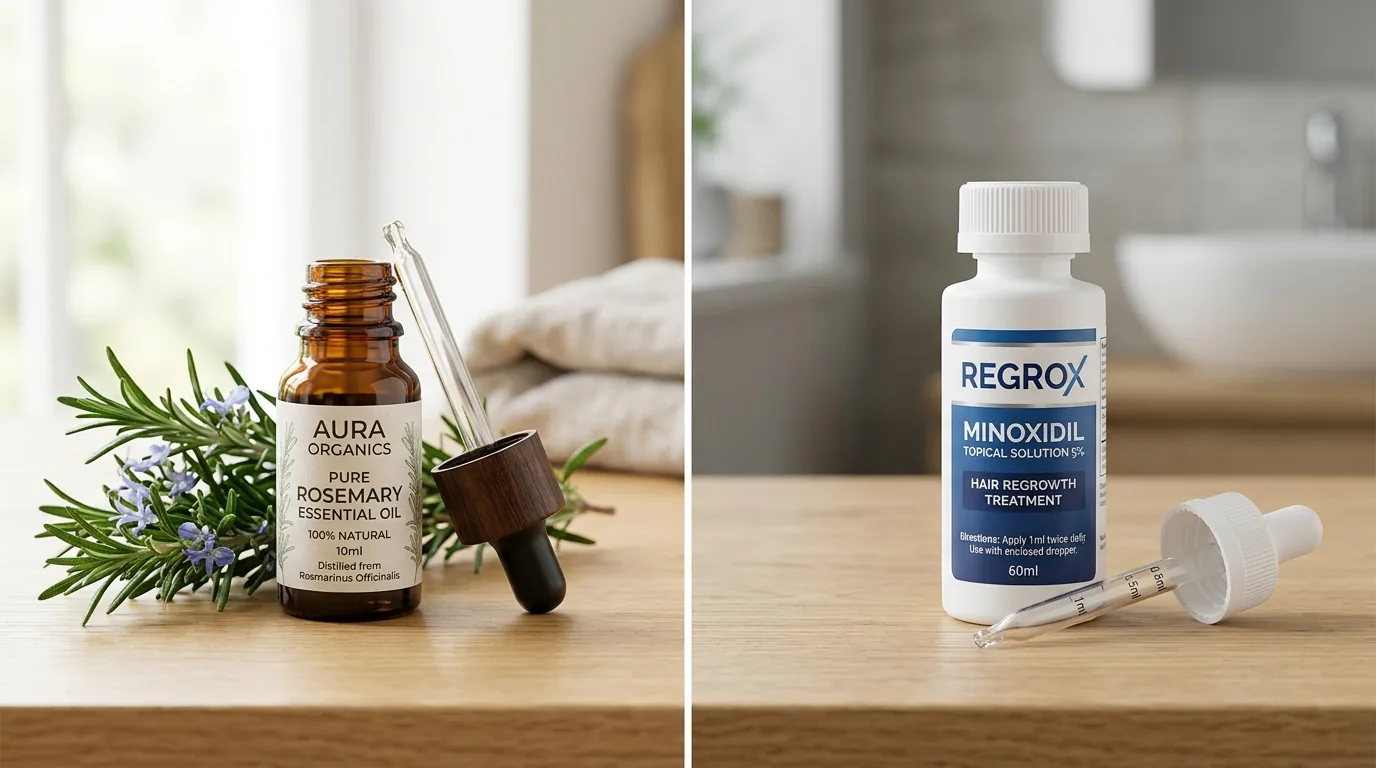
1. The Landmark Clinical Trial: Panahi et al. (2015) Analyzed
For decades, natural remedies were dismissed as anecdotal. That shifted dramatically in 2015 when Dr. Yunes Panahi and colleagues published a randomized, comparative clinical trial in SKINmed: Dermatology for the Clinician investigating whether Rosmarinus officinalis essential oil could rival pharmaceutical minoxidil 2%.
Study Methodology and Protocol
The trial randomized 100 adult patients diagnosed with androgenetic alopecia into two parallel cohorts of 50:
- Group 1: Applied a standardized topical rosemary essential oil formulation twice daily.
- Group 2: Applied commercial minoxidil 2% solution twice daily.
- Duration: 6 continuous months with standardized dermascopic macro-photographs evaluated at baseline, 3 months, and 6 months across a calibrated target zone (~1.78 cm²).
Clinical Findings: Month 3 vs. Month 6
At the 3-month checkpoint, neither group demonstrated a statistically significant increase in hair count compared to baseline—underscoring that biological follicle reactivation requires a minimum of 90 to 120 days.
By the 6-month endpoint, both cohorts exhibited a significant, robust increase in terminal hair count. Crucially, the difference in hair density between the rosemary oil group and the minoxidil 2% group was statistically non-significant (P > 0.05), with both cohorts experiencing mean count increases between 20% and 22%.
Tolerability & Scalp Pruritus Disparity
While efficacy was identical, side effect profiles diverged sharply:
| Adverse Reaction Metric | Minoxidil 2% Cohort | Rosemary Oil Cohort | Statistical Significance |
|---|---|---|---|
| Scalp Pruritus (Itching) | 44.0% of participants | 15.0% of participants | P < 0.05 (Clinically Superior) |
| Dry Scalp / Flaking | 32.0% observed scaling | 7.5% observed scaling | P < 0.05 |
| Efficacy at 6 Months | +21.8% Hair Count | +20.4% Hair Count | P > 0.05 (Equivalent) |
2. Biological Mechanisms of Action: Carnosic Acid vs. K-ATP Channel Opening
While both compounds yield hair restoration, their pharmacological pathways are entirely different:
Minoxidil: Vasodilation & Anagen Extension
Minoxidil is an ATP-sensitive potassium (K_ATP) channel opener. By hyperpolarizing vascular smooth muscle cells, it dilates perifollicular capillary beds, increasing the delivery of oxygen, glucose, and amino acids to the dermal papilla. Concurrently, it upregulates Vascular Endothelial Growth Factor (VEGF) and activates the Wnt/β-catenin signaling cascade to prematurely terminate the telogen (resting) phase and prolong the anagen (growth) phase. Crucially, minoxidil has zero effect on DHT or hormonal conversions.
Rosemary Oil: Multi-Target Phyto-Bioactives
Rosemary oil contains high concentrations of carnosic acid, 12-O-methylcarnosic acid, and rosmarinic acid. Preclinical bioassays show that carnosic acid partially inhibits type II 5-alpha reductase, blunting the enzymatic conversion of testosterone into follicle-miniaturizing dihydrotestosterone (DHT). Furthermore, rosmarinic acid scavenges reactive oxygen species (ROS) and suppresses pro-inflammatory cytokines (IL-1β, TNF-α) around inflamed follicle sheaths.
3. The Solvent Vehicle Trap: Why Minoxidil Breaks Type 4 Hairlines
Herein lies the primary clinical crisis observed by stylists at Kayla's Beauty Supply: minoxidil is formulated for scalp penetration, not hair fiber preservation.
The Alcohol & Propylene Glycol Matrix
To keep minoxidil powder dissolved in liquid form, pharmaceutical manufacturers utilize a solvent carrier composed of 50% propylene glycol, 30% denatured ethanol, and 20% purified water.
When this high-alcohol solution is applied twice daily to the perimeter of Type 4 hair:
- The alcohol dissolves the hair shaft's protective 18-methyleicosanoic acid (18-MEA) lipid layer, stripping the cuticles of lubrication.
- Because Type 4 hair already has an elliptical cross-section with acute bends that prevent sebum migration, the hairline fibers become hyper-dehydrated within weeks.
- The Paradoxical Result: Even if the follicle bulb deep in the dermis is stimulated to grow new anagen hair, the fragile hair fiber emerging at the scalp level snaps off from severe dryness. Clients report their edges looking "shorter and thinner," mistaking chemical solvent breakage for treatment failure.
The Carrier Oil Advantage for Coily Edges
In contrast, rosemary essential oil is diluted in a lipid carrier such as golden jojoba wax, pumpkin seed oil, or Jamaican black castor oil. These carriers:
- Provide biomimetic wax esters that coat and soften fragile baby hairs.
- Create an occlusive shield that locks ambient moisture into the cuticle. Learn more about lipid layering in The Moisture Retention Handbook for Type 4 Hair.
- Deliver active phytochemicals without peeling or desiccating the delicate stratum corneum along the forehead.
4. The "Dread Shed" Phenomenon: Emotional Tolerability
One of the most psychologically distressing aspects of beginning topical minoxidil is the initial shedding phase (known clinically as drug-induced telogen effluvium).
When minoxidil accelerates follicle transit into anagen, it causes telogen-phase hairs to rapidly eject from the follicle funnel between weeks 2 and 8. For clients already self-conscious about a receding hairline or thinning temples, watching hundreds of fragile edge hairs fall out in the bathroom sink causes intense panic, leading over 40% of users to discontinue treatment before the 6-month benefit window.
Rosemary oil, due to its multifaceted anti-inflammatory and gentle microvascular modulation, demonstrates a far more gradual follicular transition. While minor shedding can theoretically occur as healthy cycles reset, severe "dread shed" spikes are remarkably rare, making it vastly superior from a client compliance standpoint.
5. Traction Alopecia vs. Androgenetic Alopecia: Choosing Your Therapy
Selecting between rosemary and minoxidil depends entirely on diagnosing the root cause of your hairline thinning:
Scenario A: Mechanical Traction Alopecia
Caused by tight knotless braids, heavy dreadlocks, high ponytails, or aggressive lace glue removal. The pathology is mechanical follicular distention, peribulbar inflammation, and micro-scarring. Optimal Choice: Rosemary Oil diluted in Jojoba and Castor Oil. The anti-inflammatory terpenes calm the damaged sheath while the heavy lipids restore the perimeter barrier. Pair this with tension-free braid protocols from Knotless Box Braids & Tension Alopecia Prevention.
Scenario B: Genetic Androgenetic Alopecia
Characterized by progressive miniaturization of follicles across the crown, central part, or temples independent of styling tension. Optimal Choice: Minoxidil 5% Foam or Combined Therapy. Minoxidil remains the gold standard for genetic androgenetic thinning. However, to avoid vehicle damage, clients with Type 4 hair should use propylene glycol-free foam or layer an emollient oil over the hair fiber 30 minutes after minoxidil absorption.
6. Master Salon Formulation & Edge Recovery Protocol
If you choose the natural botanical route, formulate your edge serum using this precise salon recipe:
Kayla's 2.5% Bioactive Rosemary Hairline Elixir
- • Carrier Base (30 ml total): 15 ml Golden Jojoba Oil (matches human sebum) + 10 ml Cold-Pressed Pumpkin Seed Oil (natural 5-alpha reductase phytosterols) + 5 ml Jamaican Black Castor Oil (moisture occlusion).
- • Active Extract: 15 drops of 100% Pure Steam-Distilled Rosmarinus officinalis (ct. cineole or ct. verbenone).
- • Antioxidant Stabilizer: 2 drops Pure Vitamin E (Tocopherol) oil to prevent lipid rancidity.
Frequently Asked Questions: Rosemary Oil & Minoxidil
Did the 2015 Panahi study prove rosemary oil works as well as minoxidil?
Yes. The landmark 2015 randomized clinical trial published by Panahi et al. in SKINmed evaluated 100 participants over 6 months. By month 6, both the rosemary oil and minoxidil 2% cohorts exhibited statistically equivalent, significant increases in hair count (approximately 20–22% increase). Crucially, the minoxidil group suffered significantly higher rates of scalp itching (44%) compared to rosemary oil (15%).
Why does commercial minoxidil break fragile edges on Type 4 hair?
Standard over-the-counter liquid minoxidil formulations are dissolved in a solvent base of 50% propylene glycol, 30% denatured ethanol, and 20% water. On tightly coiled Type 4 hair—which already experiences reduced sebum migration—repeated alcohol exposure dehydrates the hair cuticle, causing perimeter coils to become brittle and snap off mechanically even as the follicle bulb is stimulated.
What is the "dread shed" and does rosemary oil cause it?
The "dread shed" is drug-induced telogen effluvium triggered by minoxidil abruptly forcing dormant telogen follicles into the active anagen growth phase, causing noticeable hair shedding between weeks 2 and 8. Because rosemary oil works via gentler microcirculatory and mild 5-alpha reductase pathways, patients rarely report dramatic shedding spikes, making it emotionally easier for individuals with sparse edges.
How should rosemary oil be diluted for sensitive hairline edges?
Pure rosemary essential oil must never be applied undiluted. It should be diluted to a 2% to 3% concentration: approximately 3 to 5 drops of pure Rosmarinus officinalis essential oil per tablespoon (15 ml) of a biocompatible carrier oil such as golden jojoba, cold-pressed pumpkin seed, or Jamaican black castor oil.