Diffusing vs. Hooded Dryer vs. Air Drying: The Biophysics of Curl Shrinkage & Hygral Fatigue in Type 4 Hair
In the natural hair community, air drying has long been celebrated as the ultimate heat-free holy grail. Yet trichological research reveals a startling paradox: letting thick Type 4 coils air dry for eight hours often inflicts more permanent structural damage than controlled, indirect thermal drying. From helical recoil physics to cell membrane delamination, here is how drying methods dictate curl shrinkage, definition, and cuticle health.
Core Biophysical Takeaways
- 1. Shrinkage Demonstrates Health: Type 4 curls experience 50% to 85%+ shrinkage due to asymmetrical elliptical cross-sections and intense helical recoil. Elastic shrinkage is proof of undamaged cortex proteins.
- 2. The Air Drying Hazard: Leaving high-density coils soaked for 6 to 10 hours causes water-induced swelling of the cortex, progressively degrading the Cell Membrane Complex (CMC) and fueling scalp fungal overgrowth.
- 3. Hooded Dryer Superiority: Indirect convective airflow between 40°C and 55°C safely accelerates water evaporation without disrupting the gel cast, delivering maximum elongation and zero cuticle flaring.
- 4. The Bubble Hair Threshold: Direct high heat (>140°C) applied to damp hair flashes trapped water to steam, exploding hollow cavities within the cortex. Indirect diffusing completely avoids this thermal destruction.
1. The Biophysics of Curl Shrinkage: Helical Recoil in 4A, 4B, and 4C Hair
Curl shrinkage is the defining mechanical characteristic of afro-textured hair. When wet or stretched taut, a strand reveals its true anatomical length; but as moisture evaporates and hydrogen bonds recrystallize, the hair snaps back into a compact helical coil.
Shrinkage Percentages Across Type 4 Textures
Shrinkage is calculated as the percentage reduction between stretched wet length and dry resting length:
Defined "S"-shaped coils with visible spring diameter (~crochet needle size). Moderate recoil with noticeable vertical drop.
Sharp "Z"-shaped angles with acute bends. Higher torsional resistance and dramatic volume expansion upon drying.
Tight micro-helices with minimal individual definition. A 12-inch stretched strand routinely compacts down to 2.5 inches.
This immense recoil is driven by the hair's elliptical geometry and the uneven distribution of orthocortical and paracortical keratin cells across the strand's inner and outer curve radii. When hair is healthy and elasticity is intact, shrinkage is maximized. Learn how protein integrity maintains this elasticity in Protein-Moisture Balance: Hygral Fatigue vs. Protein Overload.
2. The Hidden Hazard of Air Drying: CMC Delamination & Hygral Stress
For years, natural hair influencers promoted air drying as the safest method because it involves zero heat. However, modern cosmetic dermatology paints a very different picture.
What Happens Inside a Water-Saturated Hair Shaft?
When hair is saturated with water, the cortex swells by up to 15% to 20% in diameter. In thick, high-density Type 4 hair, complete air drying can take anywhere from 6 to 12 hours, especially in humid climates like South Florida.
During this prolonged soaking period:
- Cell Membrane Complex (CMC) Delamination: The CMC is the intercellular lipid adhesive (composed of ceramides, free fatty acids, and cholesterol) that bonds cuticle scales together and anchors them to the cortex. Long hours of aqueous swelling cause this lipid glue to dissolve and separate, leading to chipped, flaring cuticles.
- Microbial Scalp Colonization: Leaving the scalp damp for half a day creates a warm, occluded greenhouse environment. Opportunistic lipophilic fungi, notably Malassezia globosa, proliferate rapidly, feeding on sebum and excreting oleic acid that triggers seborrheic dermatitis, dandruff, and severe itching.
The Clinical Verdict: Controlled indirect heat that dries the hair in 30 to 45 minutes is biologically far less damaging to the hair fiber than allowing strands to remain water-swollen for 8 hours.
3. Thermal Mechanics: Hooded Dryers vs. Diffusers vs. Direct Heat
To prevent thermal fatigue, you must understand the temperature thresholds of human alpha-keratin:
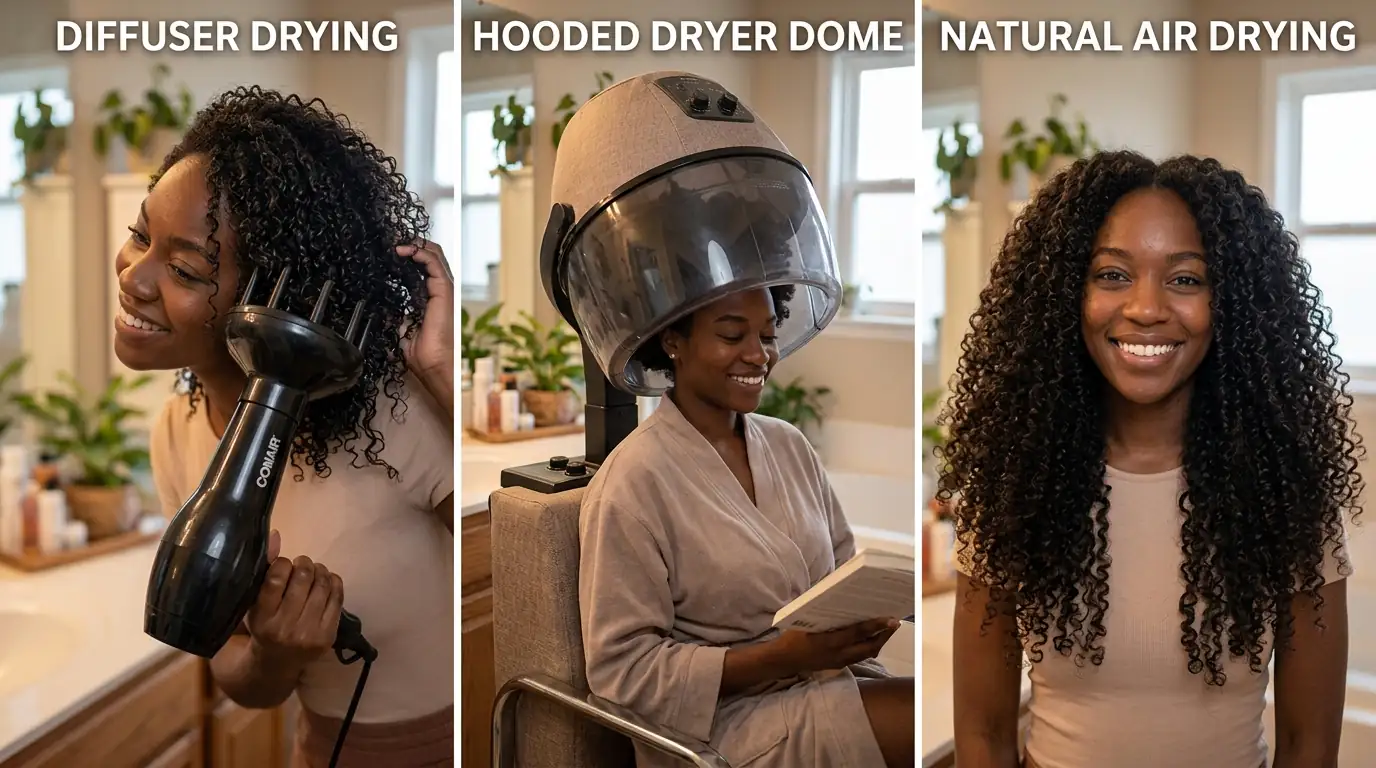
A hard-hat hooded dryer circulates warm air evenly downward around the perimeter of the skull without forceful localized air pressure. This sets styling gels and mousses into a rigid, protective cast without disturbing delicate coil clumps. Because gravity pulls downward as hair dries, hooded dryers yield the highest elongation (least shrinkage) of any drying technique.
A diffuser attachment baffles high-velocity air, breaking it into dozens of micro-streams. When used via the hover technique (holding the bowl 2 inches away without touching), it dries curls gently with moderate elongation. When used via the scrunch technique (cupping coils into the prongs and lifting toward the scalp), it maximizes root volume and coil bounce while increasing shrinkage.
When wet hair is subjected to direct, un-diffused heat above 140°C, moisture trapped inside the cortex boils instantly into steam. As water vapor expands, it ruptures the keratin structure, creating microscopic hollow cavities known as bubble hair. The affected shaft becomes permanently deformed and snaps under minimal tension.
4. Comprehensive Performance Matrix: Drying Methods Compared
Compare the four primary drying protocols across key salon benchmarks for Type 4 hair:
| Performance Metric | Hooded Dome Dryer | Diffuser (Hover Method) | Natural Air Drying |
|---|---|---|---|
| Drying Duration | 30 to 45 Minutes | 20 to 35 Minutes | 6 to 10+ Hours |
| Curl Elongation | Maximum (Sets with gravity) | Moderate | Minimal (Max Shrinkage) |
| Frizz Resistance | Superior (Zero wind shear) | High (Preserves cast) | Poor (Frictional frizz) |
| Hygral Fatigue Risk | Near Zero | Near Zero | High (Chronic swelling) |
| Scalp Ecology Health | Optimal (Dry roots) | Optimal | Poor (Promotes yeast) |
5. Kayla's 5-Step Master Salon Drying Protocol for Type 4 Hair
Follow this sequence to preserve hair fiber integrity while minimizing shrinkage:
- Microfiber Absorption Blotting: After rinsing conditioner, gently squeeze excess water with a 100% microfiber towel or cotton t-shirt. Never rub vigorously, as wet cuticles are highly vulnerable to mechanical abrasion.
- Apply Leave-In & Sealant Cast: While hair is still damp, apply your leave-in conditioner and a water-based defining gel or foam. Ensure every curl clump is coated to lock in moisture and create a firm setting cast. Consult our layering rules in LOC vs. LGO: Penetration Chemistry.
- Execute the 15-Minute Hooded Foundation: Sit under a warm hooded dryer (medium heat setting, ~45°C) for 15 minutes. This rapidly sets the exterior gel cast and evaporates surface water before curls have a chance to shrink.
- Target Roots with Diffuser: If full hooded drying isn't available, switch to a diffuser. Hover around the perimeter on low speed and medium heat for 10 minutes, focusing on lifting dense roots to ensure the scalp is thoroughly dry.
- The Cold Air Lockout: Finish with 2 minutes of cool air. Cold temperatures lower the cuticle plates and vitrify styling polymers, sealing the hair against ambient humidity. Review weekly moisture protocols in The Moisture Retention Handbook for Type 4 Hair.
Frequently Asked Questions: Curl Drying Science
Why is air drying considered dangerous for dense Type 4 hair?
Dense Type 4 hair can remain wet for 6 to 10 hours when air dried. Extended saturation keeps the hair cortex constantly swollen with water, placing chronic mechanical strain on the Cell Membrane Complex (CMC)—the intercellular lipid glue holding cuticles to the cortex. This chronic expansion-contraction cycle induces hygral fatigue, cuticle peeling, and creates a damp breeding ground for Malassezia yeast on the scalp.
How much shrinkage is normal for 4A, 4B, and 4C hair?
Shrinkage is a biophysical indicator of healthy elasticity. Normal resting shrinkage ranges from 50% to 60% for Type 4A coils, 65% to 75% for Type 4B zig-zag patterns, and 75% to 85%+ for Type 4C micro-coils. A 12-inch 4C strand can naturally rest at just 2 to 3 inches in visible length.
Does a hooded dryer cause heat damage to natural coils?
No, when operated properly. Professional hooded dryers deliver indirect convective heat at gentle temperatures between 40°C and 55°C (104°F–131°F), far below the 140°C threshold where keratin denatures. Because airflow circulates evenly downwards without high-velocity mechanical disturbance, hooded drying sets styling gel casts with minimal frizz and superior elongation.
What is the difference between hover diffusing and scrunch diffusing?
Hover diffusing involves holding the diffuser nozzle 2 to 3 inches away from the hair without touching it, allowing indirect warm air to gently dry the exterior gel cast to prevent frizz. Scrunch diffusing involves gathering curls into the diffuser bowl and pressing upward towards the scalp, which maximizes volume and curl bounce but accelerates shrinkage.