Chebe Powder & Fermented Rice Water: The Biophysics of Length Retention vs. Growth Myths
Social media is saturated with viral promises claiming that Chadian Chebe powder and fermented rice water can double your genetic hair growth rate overnight. But what does peer-reviewed cosmetic trichology actually say? By separating folktales from biological mechanisms, we uncover the true power of these ancestral rituals: pure, uncompromised mechanical length retention.
Core Scientific Takeaways
- 1. Retention vs. Growth Rate: Human hair follicles grow at an average rate of 0.35 to 0.5 inches per month, regulated by genetics, vasculature, and endocrine signaling. Neither Chebe nor rice water accelerates follicle cell division; they stop the distal ends from breaking off.
- 2. Chebe's Plant Resin Barrier: Seeds of Croton gratissimus yield hydrophobic resinous polymers, volatile oils, and flavonoids that coat the cuticle, preventing evaporation and dampening mechanical shear stress during styling.
- 3. Inositol Internal Reinforcement: Rice fermentation synthesizes inositol, a cyclic polyol that penetrates through lifted cuticle margins to strengthen the inner cortex and maintain elasticity across humidity cycles.
- 4. The Protein Overload Hazard: Misusing fermented rice water as a daily leave-in creates excessive surface protein cross-linking, inducing acute brittleness and catastrophic snapping in low-porosity coils.
1. Cultural Origins: How Basara and Red Yao Traditions Preserved Extreme Length
To understand why these ingredients became viral sensations, one must examine their ethnographic roots. Two distinct global cultures achieved floor-length hair without commercial cosmetics or synthetic conditioners:
The Basara Arab Women of Chad
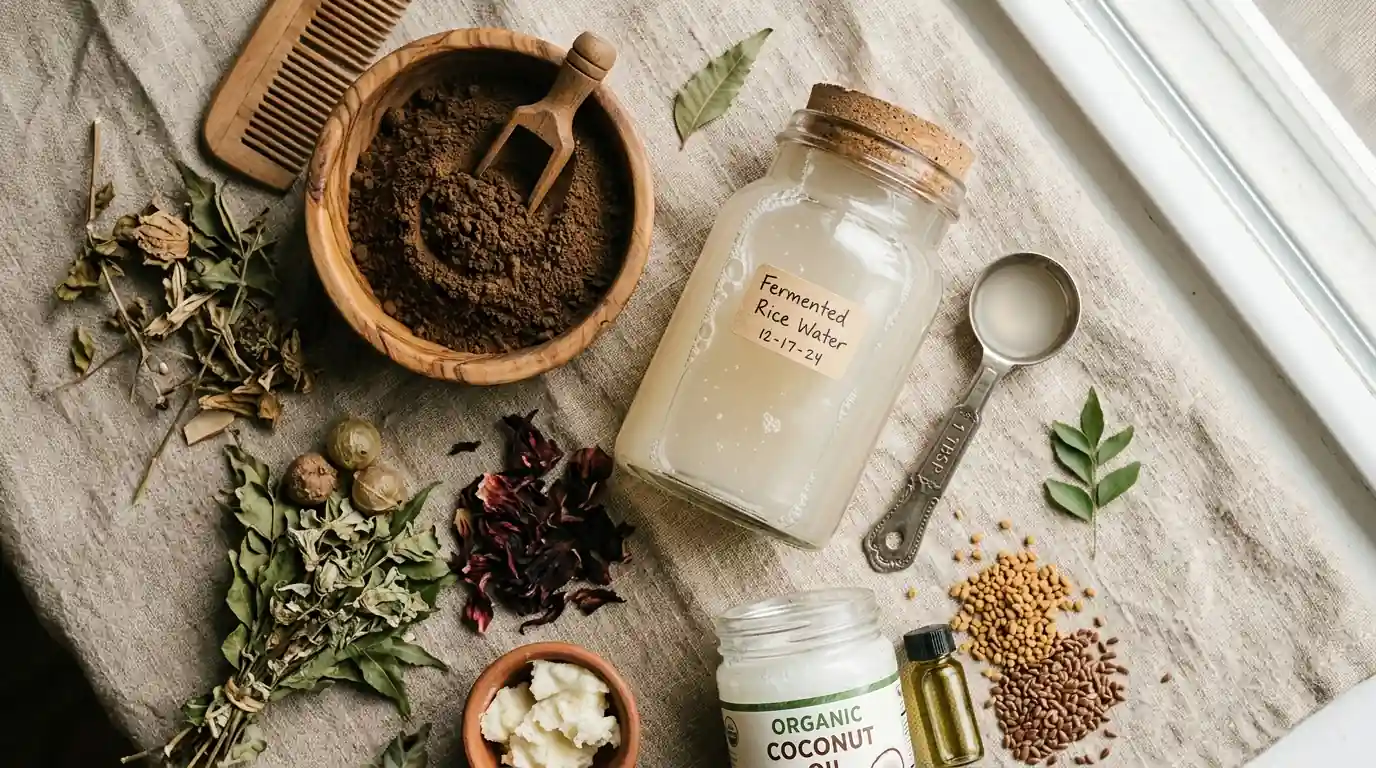
In the arid Sahel region of Chad, Basara women are famed for ankle-length, thick Type 4 hair. Their multi-century regimen involves grinding the roasted seeds of Croton gratissimus (locally called Chebe), mixing it with aromatics like Mahllaba (cherry kernels), Misic (plant resin), and Samour (clove). They repeatedly coat damp hair lengths in Chebe paste mixed with animal tallow or shea butter, braided down in heavy, tension-free plaits without ever washing it completely out.
The Red Yao Women of Huangluo, China
Holding Guinness World Records for the "World's Longest Hair Village," the Red Yao women of Guangxi province wash their straight and wavy hair with fermented sticky rice water infused with pomelo peels and tea seed cakes. Fermented in wooden vats to drop the pH to acidic levels, this cloudy rinse yields lustrous, breakage-resistant hair well past their 70s.
Notice the common thread: neither culture washes their hair daily with drying surfactants, and both pair their treatments with rigorous protective styling and minimal physical manipulation.
2. Phytochemical Analysis: What Is Actually Inside Chebe & Rice Water?
When evaluated in a cosmetic laboratory, both substances exhibit distinct biophysical properties that explain why they alter hair tactile quality:
Biochemistry of Chadian Chebe (Croton gratissimus)
Croton gratissimus contains high concentrations of lipophilic diterpenoids, triterpenes, and complex plant tannins:
- Hydrophobic Resins: These natural waxes do not dissolve in water. When mixed with an emollient like shea butter or castor oil, they form a physical sleeve around the hair shaft that locks internal water molecules inside the cortex.
- Antimicrobial Tannins: Natural polyphenols safeguard the hair strand against environmental degradation, oxidation, and microbial breakdown over long protective styling cycles.
- Volatile Essential Oils: Terpenes provide natural aromatics that deodorize hair while it remains unwashed in braids for 5 to 7 days.
Biochemistry of Fermented Rice Water (Oryza sativa)
Fermenting rice water with ambient or inoculated yeast breaks down macromolecular starches into bioavailable micro-nutrients:
- Inositol (Cyclic Hexitol): Studies in the Journal of Cosmetic Chemists confirm that inositol possesses unique fiber-penetrating properties. Because of its compact molecular conformation, it slides beneath lifted cuticle scales and lodges inside damaged voids, remaining detectable even after extensive surfactant washing.
- Free Amino Acids & Hydrolyzed Proteins: Fermentation cleaves heavy rice proteins into peptide chains that adsorb to negative charge sites along the damaged cuticle sheath.
- Acidic Organic Byproducts: Fermentation naturally lowers the pH of the rinse to 4.0–4.5, perfectly matching the biological isoelectric point of human hair (pH 3.67), which forces flared cuticles to close tight.
3. The Growth Myth vs. The Length Retention Reality
In commercial beauty marketing, the term "hair growth" is routinely conflated with "length retention." This deception creates unrealistic expectations and improper product usage:
| Parameter | Biological Hair Growth | Mechanical Length Retention |
|---|---|---|
| Site of Action | Dermal Papilla & Follicle Bulb | Hair Shaft Cortex & Cuticle Layer |
| Primary Mechanism | Cellular mitosis, microvascular perfusion, IGF-1 signaling | Cuticle sealing, tensile reinforcement, friction dampening |
| Chebe Impact | 0% Direct Follicular Impact | 95% Breakage Reduction via Resin Coating |
| Rice Water Impact | 0% Proven Mitotic Stimulation | 80% Elasticity Improvement (Inositol) |
Most individuals with Type 4 hair who believe their hair "refuses to grow past the collarbone" are actually producing normal rates of root growth (6 inches per year). However, due to single-strand knots, friction against clothing, and dryness, the ends are snapping off at 6 inches per year, resulting in net zero visible progress. By halting breakage, Chebe and rice water unlock the illusion of rapid growth. To align this with your weekly routine, consult our foundational Moisture Retention Handbook for Type 4 Hair.
4. The Clinical Hazards of Overuse: Protein Overload & Folliculitis
More is not always better. When modern consumers apply ancestral rituals without understanding their biochemical boundaries, significant damage can ensue:
Rice water is concentrated with small amino chains. If you have low-porosity coils (which already feature tightly shut cuticle scales), these proteins accumulate on the exterior fiber, forming a brittle, hardened shell. The strand loses its flexibility and shatters upon the slightest bending. Learn how to test your strand elasticity in Protein-Moisture Balance: Hygral Fatigue vs. Protein Overload.
Basara women strictly apply Chebe to the hair length, never the scalp. When modern DIY users rub granular Chebe paste into their scalp skin, the coarse mineral grains and insoluble resin particulates become lodged inside follicular orifices. This triggers mechanical inflammation, severe pruritus (itching), and pustular folliculitis that requires medical intervention.
Leaving homemade rice water on your kitchen counter for 3 to 5 days without antimicrobial preservatives allows opportunistic pathogens—including Bacillus cereus and Malassezia yeasts—to flourish. Pouring this contaminated brew over a compromised scalp barrier can ignite chronic dandruff, seborrheic flares, and fungal infections.
5. The Salon Protocol: Safe Application for 4A–4C Textured Hair
Kayla's Beauty Supply master stylists recommend the following structured protocol to harness the retention benefits while avoiding protein overload:
Protocol A: The Bi-Weekly Fermented Rice Water Strengthening Rinse
- Rinse 1 cup of organic jasmine or basmati rice thoroughly to remove surface dirt. Place in 2 cups of distilled water for 30 minutes, agitating vigorously until milky.
- Strain the water into a clean glass mason jar. Add 2 dried orange peels (to lower pH and neutralize yeast odors). Allow it to ferment at room temperature for strictly 24 hours (not 3 days).
- Transfer immediately to the refrigerator to halt fermentation. Use within 5 days.
- After shampooing, saturate hair with the diluted rice water (1 part rice water to 1 part distilled water). Massage through mid-lengths for 5 minutes.
- Crucial Step: Thoroughly rinse out with cool water and follow immediately with a moisturizing, protein-free deep conditioner to maintain structural elasticity. Review layering sequences in LOC vs. LGO: Penetration Chemistry.
Protocol B: The Chebe Length Retention Butter Plait
- Sift 2 tablespoons of authentic Chadian Chebe powder through an ultra-fine mesh to eliminate sharp, coarse granules.
- Melt 4 tablespoons of raw shea butter or cupuaçu butter, then blend with 2 tablespoons of Jamaican black castor oil and the sifted Chebe powder. Allow to cool into a whipped pomade.
- Mist freshly washed, detangled Type 4 hair with pure water or aloe vera juice until 70% damp.
- Starting 1.5 inches away from the scalp, apply a small amount of the Chebe butter down the length of each section, paying special attention to the fragile ends.
- Braid or two-strand twist the section snugly. Leave the braids in place for 7 to 14 days under a satin bonnet. When taking down, rinse thoroughly with warm water and a sulfate-free co-wash.
Frequently Asked Questions: Chebe & Rice Water
Does Chebe powder make hair grow faster from the scalp?
No. Chebe powder does not stimulate cellular mitosis inside the hair follicle matrix, nor does it alter the biological anagen growth phase rate. Instead, it acts as a physical resinous sheath that seals the hair cuticle, dramatically reducing mechanical snapping and friction so that the hair you grow is retained rather than broken off.
Why can fermented rice water cause brittle hair and breakage?
Fermented rice water is rich in low-molecular-weight amino acids and vegetable proteins. When applied too frequently or left un-rinsed on low-porosity or protein-sensitive Type 4 coils, it induces severe protein overload. The excess protein deposits stiffen the keratin core, causing hair strands to lose elasticity and snap under gentle tension.
Can I apply Chebe paste directly onto my scalp?
Basara and Baggara women traditionally avoid applying Chebe paste to the scalp. The coarse botanical particulates, resins, and alkaloids can clog follicular ostia, trap sebum and sweat, and incite contact dermatitis or mechanical folliculitis. Chebe must be applied strictly to the hair shaft starting 1 inch away from the roots down to the ends.
What is the key active compound in fermented rice water that aids hair integrity?
The primary active is inositol (a cyclic carbohydrate/sugar alcohol). Biophysical studies demonstrate that inositol penetrates deeply into damaged hair fibers, remaining inside the cortex even after thorough rinsing, where it provides continuous internal elasticity and diminishes inter-fiber friction.