7-Day Humidity Defense for Silk Presses: Stylist Protocols
In South Florida's coastal climate, maintaining a glassy, mirror-shine silk press on Type 4 coily hair feels like defying atmospheric physics. When relative humidity hovers between 80% and 95%, untreated natural hair can revert to a tight afro within sixty seconds of stepping outdoors. How do celebrity master stylists guarantee week-long silk press longevity without burning the cuticle or causing heat damage?
The Science of 7-Day Anti-Reversion Performance
- 1. Hydrogen Bond Kinetics: Thermal pressing only temporarily alters water-labile hydrogen bonds. Halting curl reversion requires slowing moisture sorption kinetics through surface hydrophobicity.
- 2. Protecting the 18-MEA Epicuticle F-Layer: Natural hair repels atmospheric moisture through a lipid monolayer. Preserving this boundary during washing is the foundational defense against swelling.
- 3. Functional Silicone & Polymer Shields: Aminofunctional silicones (amodimethicone) and fluoropolymer films form a breathable, micro-thin moisture barrier without weighing down fine coils.
- 4. Single-Pass Thermodynamics: Multiple passes with high-heat flat irons scorch hair cuticles. A single controlled pass at 380°F–400°F paired with a high-tension carbon comb chase maximizes smoothness with minimal heat exposure.
1. The Physics of Curl Reversion: Moisture Sorption in High-Humidity Climates
To master humidity resistance, one must first deconstruct the molecular physics of the hair shaft. Human hair is a composite biological fiber made primarily of keratin proteins organized into organized alpha-helices embedded in an amorphous, cystine-rich matrix.
Hair fibers maintain their shape through two primary chemical linkages: permanent, covalent disulfide bonds (which require chemical relaxers or perms to restructure) and temporary, physical hydrogen bonds. When a stylist performs a silk press, heat and mechanical tension dislodge hydrogen bonds holding the natural coil configuration. As the hair cools and dries in an elongated state, new hydrogen bonds form, temporarily locking the strand straight.
However, keratin is intensely hygroscopic. Research published in the International Journal of Cosmetic Science (Breakspear, Evans et al., PMID: 39528912) shows that moisture sorption kinetics accelerate rapidly as ambient vapor pressure rises. When a client steps into an 85%+ relative humidity environment (such as an August afternoon in Pembroke Pines or Miami, matching the extreme dew points tested in our South Florida humidity edge controls field test), atmospheric water molecules instantly penetrate the porous outer cuticle.
As water penetrates into the cortex, it plasticizes the keratin protein chains, cleaving the newly formed straight hydrogen bonds. Relieved of their thermal configuration, the internal elastic peptide chains snap back into their genetically encoded curvature—a phenomenon known trichologically as hygral curl reversion.
Elliptical Geometry & Reversion Stress
Type 4 fibers possess an elliptical (flattened ribbon) cross-section with high asymmetry. When water sorbs unevenly across the major and minor axes of the cortex, differential swelling creates torsional strain, causing coils to curl up and shrink faster than circular Asian or Caucasian hair fibers.
The Hygral Swelling Hazard
As hair absorbs up to 30% of its dry weight in atmospheric water, the diameter of the fiber swells by 14% to 16%. This lateral expansion forces cuticle scales to lift outward, creating dullness, rough tactile texture, and severe frizz along the hair shaft.
2. Chemical Armor: Hydrophobic Film Formers & The 18-MEA Cuticle Shield
Because hydrogen bonds are inherently sensitive to moisture, a successful 7-day silk press requires an impenetrable chemical vapor shield. Virgin, undamaged hair naturally possesses this barrier in the form of the epicuticle F-layer—a single molecular monolayer of 18-methyleicosanoic acid (18-MEA) linked covalently via thioester bonds to keratinocytes (PMCID: PMC9921463).
The 18-MEA layer makes the hair surface completely hydrophobic, causing water droplets to bead up and roll off. However, routine weathering, high-pH clarifying shampoos, and prior heat styling degrade 18-MEA, transforming the cuticle into a hydrophilic sponge.
In professional salon suites, stylists replenish this barrier using advanced hydrophobic film formers:
1. Aminofunctional Silicones (Amodimethicone)
Unlike heavy dimethicone, which builds up unevenly, amodimethicone features cationic amino groups that bond selectively to negatively charged, damaged sites on the hair cuticle (Gavazzoni Dias, PMID: 25878443). Once bound, its terminal methyl groups face outward, establishing a durable, hydrophobic sheath that repels humidity while preventing excess product buildup.
2. Trimethylsiloxysilicate & Silicone Resins
These cross-linked silicone resin networks form an ultra-flexible, water-impermeable matrix over the cuticle scales. When activated under blow-dry heat, the polymer cross-links across the hair shaft, resisting atmospheric vapor penetration even at 90% ambient humidity.
3. Hydrophobic Fluoropolymer Sprays
High-tier salon humidity shields utilize perfluoropolyether and fluorosilicone polymers that dramatically lower hair surface energy. Moisture in the air cannot condense or wet the hair fiber, preserving the flat-ironed alignment without stiffness or sticky residue.
3. The Salon Prep Protocol: Chelating, Clarifying & Moisture Balancing
At Kayla’s Beauty Supply, we teach that a silk press is won or lost at the shampoo bowl. If old silicones, heavy pomades, or municipal water minerals coat the hair shaft before pressing, heat traps those contaminants, cooking them into the cuticle and guaranteeing premature reversion.
The Master Stylist 4-Stage Wash Protocol
- Stage 1: Chelating Pre-Cleanse: In South Florida, tap water is laden with calcium, magnesium, and chlorine ions. These metal salts bind electrostatically to keratin, creating a microscopic sandpaper texture that attracts atmospheric humidity. An EDTA-based chelating wash dissolves these mineral deposits in 3 minutes.
- Stage 2: Low-Sulfate Clarifying Wash: Follow with a gentle clarifying shampoo (pH 5.0–5.5) to dissolve oxidized sebum and edge-control wax without stripping the underlying intercellular lipids of the hair cuticle.
- Stage 3: Hydrolyzed Silk & Keratin Micro-Infusion: Apply a deep conditioning treatment fortified with hydrolyzed silk proteins (under 1,000 Daltons) and panthenol. These micro-proteins penetrate into cortex micro-voids, reinforcing internal structural integrity (Int J Cosmet Sci, PMID: 35689553).
- Stage 4: Acidic Porosity Sealing Rinse: Finish with a cool-water acidic rinse (pH 4.0–4.5). The low pH contracts the hair fiber, tightly shingling the cuticle scales flat over the cortex before thermal styling begins (a biological mechanism detailed in our cuticle porosity and hydration science guide).
4. Precision Thermal Mechanics: Tension Blowout & The Carbon Comb Chase
A common novice error is relying on the flat iron to do 80% of the straightening work. In reality, the flat iron should only supply the final 15% of polish. Over-relying on flat iron passes degrades the hair's natural elasticity and causes bubble hair deformity (PMCID: PMC12308778).
The tension blowout is where the silk press is actually engineered:
- Directional Concentrator Airflow: Always attach a narrow concentrator nozzle to the ionic blow dryer. Hold the nozzle parallel to the hair strand, aiming downward from root to tip. This forces cuticle scales to lie flush against each other.
- The 100% Bone-Dry Standard: If even 2% residual water remains inside the cortex when the flat iron clamps down, that water flashes instantly into superheated steam. The expanding steam ruptures cortex cavities from within, forming irreversible "bubble hair" defects that break at the slightest manipulation.
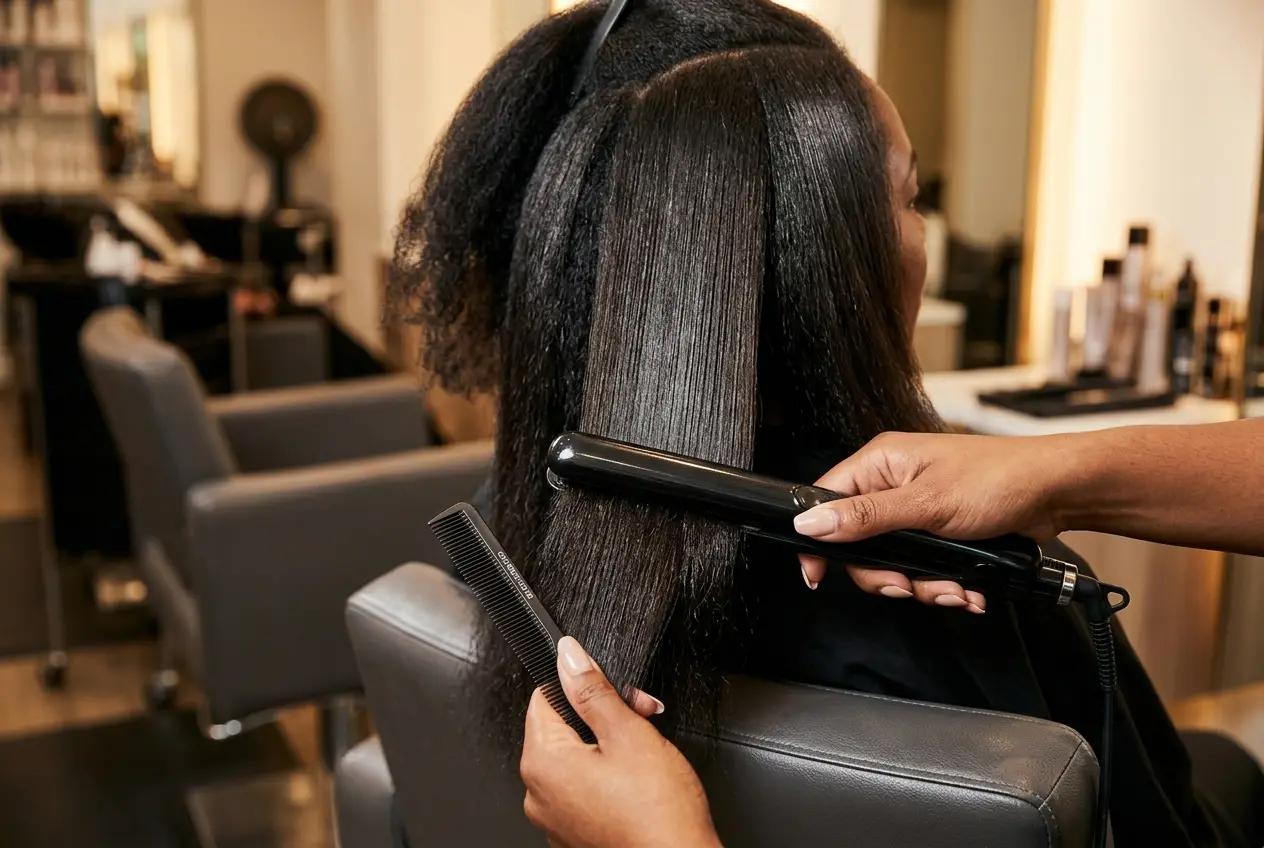
- The Carbon Comb Chase Method: Divide hair into paper-thin, 1/4-inch sections. Place a fine-toothed antistatic carbon comb directly in front of the flat iron plates. The comb separates individual hair strands, ensuring uniform heat transfer and preventing hair fibers from clumping together.
- Single-Pass Thermodynamics: Set the iron between 380°F and 400°F (never exceeding 410°F on Type 4 curls). Glide the iron down the section in a continuous, smooth motion at a rate of 1 inch per second. One controlled, high-tension pass achieves far greater silkiness and zero heat damage compared to three rapid, sloppy passes.
5. The 7-Day Climate Defense Protocol: South Florida Longevity
Once the client leaves the salon, environmental defense passes into their hands. In high-humidity regions, preserving a silk press for seven full days requires strict mechanical and atmospheric defense routines:
The Nightly Cross-Wrap Routine
Before bed, brush the hair in a smooth circular direction around the perimeter of the head (the classic Dominican doobie wrap). The natural curvature of the skull acts as an organic roller, keeping strands taut and flat without clips. Secure with a 22-momme 100% mulberry silk scarf to eliminate friction (as proven in our satin vs. silk friction and fiber preservation audit).
The Double Shower Shield
Plastic shower caps trap shower steam on the inside, causing condensation droplets to fall directly onto the hairline. Place a moisture-wicking terrycloth headband over the edges, tie a silk scarf over the hair, and place a waterproof shower cap over the entire assembly.
Additionally, avoid applying daily water-based moisturizers, leave-in milks, or heavy vegetable oils (like raw castor or olive oil). Water-based products cause instant reversion, while heavy oils attract airborne lint, weigh down movement, and oxidize into greasy buildup. If sheen is desired, mist half a pump of dry squalane or dimethicone-based serum into the palms and lightly skim the surface.
6. Emergency Anti-Frizz Interventions: Saving a Reverting Perimeter
If outdoor humidity begins swelling the frontal hairline on day 4 or 5, the worst response is grabbing a home flat iron and recooking the hair. Applying 400°F heat to hair coated in natural sebum and airborne dust burns those oils into the cuticle, creating brittle, charred ends that will not revert when washed.
The Zero-Heat Reset Protocol
- 1. Dry Shampoo Root Degreasing: Spray a translucent, starch-based dry shampoo at the roots to absorb scalp sweat and sebum without introducing water.
- 2. Anhydrous Balm Smoothing: Smooth a dime-sized amount of waterless edge pomade along the edges using a soft boar-bristle brush.
- 3. 10-Minute Compression Reset: Tie a silk wrap snugly across the hairline for 10 minutes while getting dressed. Body heat from the forehead smooths the hairs flat without applying damaging styling tools.
Trichological Literature & Peer-Reviewed Evidence
- International Journal of Cosmetic Science: Breakspear S, Evans T, Frueh P, et al. The kinetics of moisture sorption by hair. Int J Cosmet Sci. 2025;47(2):270–280. PMID: 39528912.
- International Journal of Trichology: Gavazzoni Dias MF. Hair cosmetics: an overview. Int J Trichology. 2015;7(1):2–15. PMID: 25878443; PMCID: PMC4387693.
- International Journal of Cosmetic Science: Kuhn S, et al. Comparing hair tensile testing in the wet and the dry state: Possibilities and limitations for detecting changes of hair properties due to chemical and physical treatments. Int J Cosmet Sci. 2022;44(4):421–430. PMID: 35689553.
- Polymers (Basel): Fernandes C, Medronho B, Alves L, Rasteiro MG. On Hair Care Physicochemistry: From Structure and Degradation to Novel Biobased Conditioning Agents. Polymers (Basel). 2023;15(3):608. PMCID: PMC9921463.
- Journal of Cosmetic Dermatology: Zi Y, Liu J, Fang S, Li M, Huang Q, Peng X. Establishment of Heat-Damaged Model for Hair. J Cosmet Dermatol. 2025;24(8). PMCID: PMC12308778.
Frequently Asked Questions: Silk Press Longevity
Why does Type 4 hair revert instantly when stepping outdoors into high humidity? ↓
A silk press straightens hair by temporarily breaking and reforming weak, water-labile hydrogen bonds between keratin polypeptide chains. When exposed to high ambient relative humidity (85%+), the hygroscopic keratin cortex rapidly sorbs atmospheric water vapor. These water molecules displace the reformed hydrogen bonds, allowing the coiled alpha-helical protein matrix to contract back into its genetically programmed curl pattern.
What flat-iron temperature is safest for a silk press on natural Type 4 hair? ↓
For fine to medium Type 4 strands, 380°F to 400°F (193°C to 204°C) provides sufficient thermal energy to reshape hydrogen bonds without degrading structural keratin. Coarse or high-density resistant coils may require up to 410°F (210°C). Heating above 420°F causes irreversible thermal denaturation of keratin proteins, oxidation of melanin pigments, and permanently impairs the hair fiber's ability to revert when washed.
Why is the blowout phase more critical for humidity resistance than flat ironing? ↓
Flat ironing only refines the surface; the tension blowout is where internal hair moisture is uniformly evacuated and cuticles are mechanically aligned. A high-tension blowout using a directional concentrator nozzle directs heat down the hair shaft, flattening cuticle scales and removing 95% of residual fiber curvature. If dampness remains inside the cortex before flat ironing, internal steam causes bubble hair deformity and immediate reversion.
How does 18-MEA protect hair against humidity-induced curl reversion? ↓
18-Methyleicosanoic acid (18-MEA) is a branched fatty acid covalently linked via thioester bonds to the outer epicuticle, forming the hydrophobic F-layer. This natural lipid boundary repels external liquid water and vapor. Chemical bleaching, aggressive alkaline shampoos, and excessive heat strip 18-MEA, leaving the hair hydrophilic and dramatically accelerating moisture sorption and frizz in humid weather.
How do you protect a silk press during hot showers without it puffing up? ↓
Never rely solely on a thin plastic shower cap, as shower steam condenses on the interior surface, transferring liquid moisture directly to straightened edges. Wrap the hair firmly into a circular cross-wrap, secure it with a snug 100% mulberry silk scarf, and place a terrycloth-lined, waterproof shower cap over the silk wrap. The terrycloth lining absorbs internal humidity while the waterproof exterior blocks steam.