Viral TikTok Textured Hair Hacks Debunked: Glycolic Acid & Rice Water Truths
In the era of 60-second beauty algorithms, DIY kitchen chemistry and repurposed facial skincare have gone viral with promises of overnight length retention, instant flake eradication, and mirror-shine hydration. But inside professional salon chairs, master stylists and certified trichologists are treating the aftermath: severe chemical scalp burns, catastrophic protein-induced brittleness, and thermal frying.
Salon Reality Check: Why Viral Hair Hacks Fail Type 4 Hair
- 1. Facial Glycolic Acid on Scalps: Formulated at an aggressive pH (~3.6) for non-sebaceous facial tissue, leave-on facial AHA toners trigger severe irritant contact dermatitis and scalp barrier collapse without treating the Malassezia yeast that actually causes dandruff.
- 2. The DIY Rice Water Trap: Unhydrolyzed raw starches cannot enter the cortex of low-porosity coils; they dry on the cuticle into a rigid, cement-like film that creates brittle fracture lines and severe breakage during detangling.
- 3. Kitchen Oil Thermal Frying: Food-grade oils (olive oil, coconut oil, mayonnaise) lack thermal dissipation polymers. Exposing oil-drenched strands to 450°F flat irons boils internal cortex water into steam blisters, destroying hair shaft integrity.
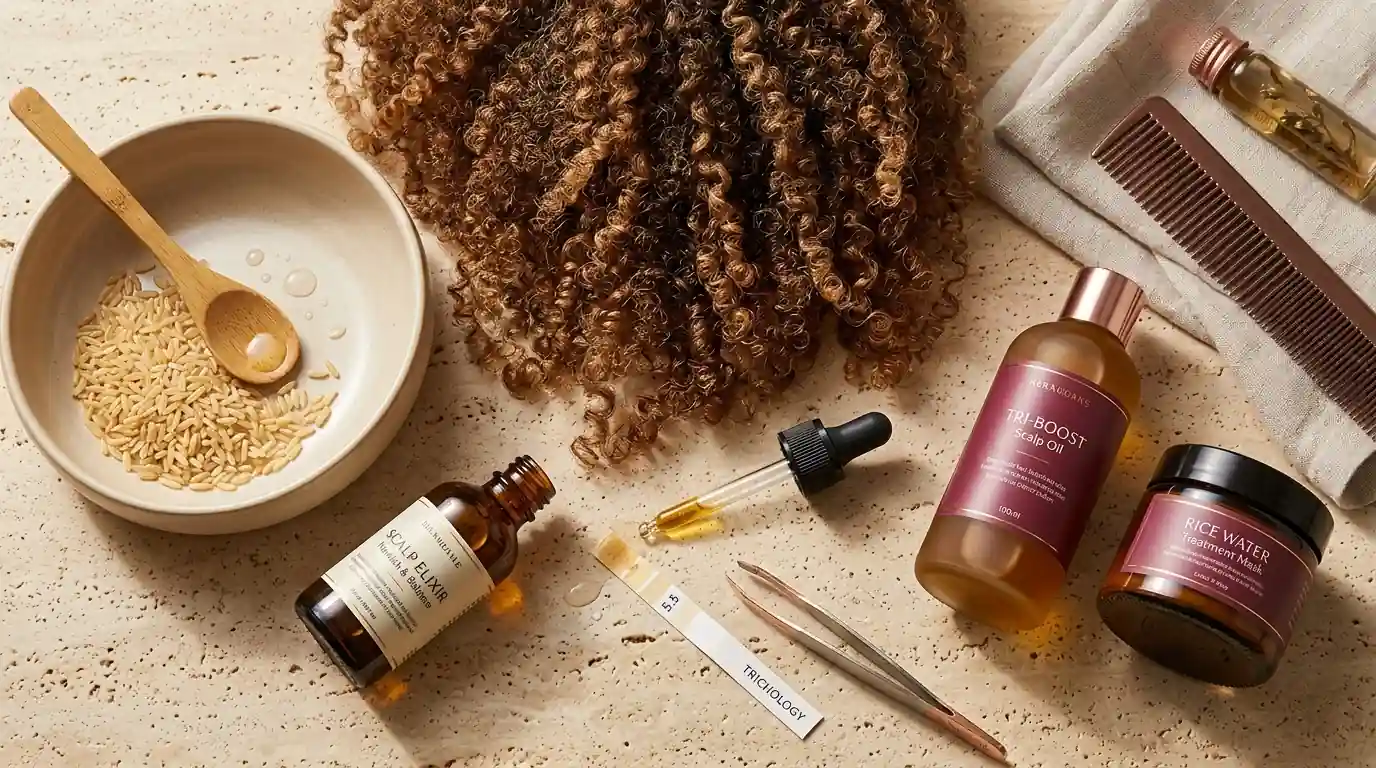
1. The Social Media Trichology Crisis: Algorithmic Virality vs. Hair Biology
Social media platforms reward dramatic visual contrasts, rapid 60-second promises, and household affordability. When an influencer claims that a \$10 drugstore facial toner permanently eliminated their flakes or that cloudy water from fermented kitchen rice yielded four inches of growth in a single month, millions of viewers follow suit.
However, Type 4 tightly coiled and kinky hair possesses unique anatomical vulnerabilities that straight or wavy hair patterns do not share. As documented in comprehensive trichological literature (Gavazzoni Dias, Int J Trichology, PMID: 25878443), textured hair fibers have an elliptical or flattened cross-sectional morphology with distinct twists along the shaft. At every curve and bend in a coil, the protective cuticle layer is naturally thinner (often only 6 to 8 cell layers deep, compared to 10 to 12 layers in Asian or Caucasian hair) and under constant internal tensile stress.
Sebaceous glands produce natural lubricating squalene and esters at the scalp. On straight hair, sebum glides down the hair shaft with gravity and brushing. On tight Type 4 coils, sebum accumulates heavily on the scalp while the mid-lengths and ends remain perpetually arid. Introducing aggressive facial exfoliants or unbuffered food pastes into this sensitive ecosystem disrupts delicate scalp lipid equilibrium and accelerates distal fiber snapping.
Let us examine the three most pervasive viral trends circulating across beauty channels, deconstruct their chemical mechanics, and review what actually occurs inside the hair shaft.
2. The 7% Glycolic Acid Scalp Hack: Exfoliation vs. Chemical Irritation
The most popular viral trend involves saturating the scalp with a high-strength (7%) glycolic acid facial toner directly from the bottle, wrapping the head in plastic, and leaving it on for 30 minutes to overnight before shampooing. Proponents claim it acts as an "anti-dandruff miracle," dissolves buildup, and "stimulates follicles" for accelerated growth.
The Biophysics of Glycolic Acid at Low pH
Glycolic acid is the smallest alpha-hydroxy acid (molecular weight: 76 Daltons). Because of its microscopic molecular size, it penetrates biological barriers with exceptional speed. Commercial facial toners are formulated at a low pH—typically between pH 3.5 and 3.8—in order to keep the acid in its un-ionized, bio-active state.
At this low pH, glycolic acid works by cleaving the protein desmosomes that cement dead corneocytes together in the uppermost stratum corneum. While this produces a smooth, reflective surface on thick facial epidermis, applying this low-pH formulation to the scalp poses severe dermatological hazards:
| Parameter | 7% Facial Glycolic Acid Toner | Trichologist Scalp Exfoliant |
|---|---|---|
| Formulation pH | pH 3.5 – 3.8 (Aggressive, unbuffered) | pH 4.8 – 5.5 (Physiological scalp range) |
| Active Mechanism | Water-soluble AHA; cannot dissolve sebum | Lipid-soluble BHA (Salicylic) + Zinc chelators |
| Antifungal Action on Malassezia | Zero (Does not kill yeast) | High (Ketoconazole / Zinc Pyrithione targets) |
| Dermatological Risk Profile | Irritant contact dermatitis, stinging, erythema | Balanced lipid preservation, gentle keratolysis |
The Dandruff Misconception: Why AHAs Cannot Cure Seborrhea
Dandruff is not merely dry skin flaking off; in over 90% of clinical cases, it is seborrheic dermatitis driven by the overgrowth of Malassezia globosa, an opportunistic lipophilic yeast that feeds on scalp sebum triglycerides and secretes irritating free fatty acids (oleic acid). Because glycolic acid is strictly water-soluble, it cannot penetrate lipid-filled sebaceous follicles where Malassezia thrives. While the acid temporarily loosens adherent surface scale, it fails to address the fungal etiology. Worse, the resulting acid burn and barrier disruption allow Malassezia to penetrate deeper into denuded tissue, triggering intensified rebound flaking and itching within 72 hours.
Furthermore, there is zero clinical evidence that applying glycolic acid stimulates the hair follicle dermal papilla or extends the anagen (growth) phase. Forcing an unbuffered facial acid onto the scalp risks chemical irritation, burning, and telogen effluvium (stress-induced shedding) from severe follicular shock.
3. Fermented Rice Water: Ancient Tradition vs. Modern Low-Porosity Reality
Few beauty trends have captured global imagination like fermented rice water, inspired by the Red Yao women of Huangluo village in China, who boast floor-length, lustrous jet-black hair well into their seventies. Modern social media tutorials instruct users to rinse raw white or brown rice, leave the water in a closed mason jar on the kitchen counter for 48 hours to ferment, and then pour the sour concoction generously over their hair as a rinse-out mask.
The Chemistry of Rice Starch vs. Low-Porosity Type 4 Coils
Rice water undeniably contains beneficial biochemical compounds, including inositol (a cyclic polyol that has demonstrated hair fiber lubrication in laboratory trials; PMID: 2456287), B-vitamins, and trace amino acids. However, over 80% of rice water solids consist of raw, unhydrolyzed amylose and amylopectin starches—complex polysaccharides with massive molecular dimensions.
The Starch Cast Catastrophe
In low-porosity Type 4 hair, cuticle scales lie tightly flat and overlapping like slate on a roof. Raw starch molecules cannot penetrate between these cuticle plates. Instead, as the hair dries, the starch cross-links and hardens on the exterior of the hair fiber, forming a brittle, inflexible film. The hair feels rough, straw-like, and stiff. When the client attempts to comb or braid the hair, this rigid coating causes microscopic fracture lines, leading to snapping and split ends.
The Microbiome Infection Risk
Traditional Yao women boiled their rice water with pomelo peel and herbs and applied it warm immediately. Modern Western DIY fermentation on a countertop lacks pasteurization, temperature regulation, and antimicrobial preservatives. Within 48 hours, the mixture ferments uncontrollably, breeding wild airborne mold spores and bacteria that create a foul, rancid stench. Pouring unpreserved bacterial soup onto a sensitive scalp frequently incites acute folliculitis and severe allergic eczema.
To achieve true protein strengthening without brittleness, textured hair requires enzymatically hydrolyzed micro-proteins (such as hydrolyzed wheat or silk protein) that have been cleaved down to molecular weights under 1,000 Daltons, allowing them to enter cortex gaps rather than drying like glue on the outside.
4. The Kitchen Oil & Mayonnaise Myth: Fat vs. Hydration
Perhaps no hair myth is as resilient as the belief that kitchen cooking oils (extra virgin olive oil, canola oil, avocado oil) and mayonnaise constitute "deep conditioning treatments." Clients arrive at our salon with hair drenched in olive oil, convinced they are infusing profound moisture into their coils.
The Fundamental Law of Trichology: Oil Is Not Moisture
Moisture is water (H2O). Hair hydration requires polar water molecules to enter the cortex, bind to keratin filaments through hydrogen bonding, and restore elasticity. Cooking oils are hydrophobic triglycerides—large, non-polar lipid clusters. With the exception of pure unrefined coconut oil (which possesses high levels of low-molecular-weight lauric acid that has been shown in grooming studies to penetrate the hair shaft and reduce protein loss; Gavazzoni Dias, 2015), most vegetable oils remain strictly on the cuticle surface.
Applying heavy kitchen oils to un-moisturized, dry hair simply forms an impenetrable hydrophobic barrier that seals dryness in and prevents subsequent water, leave-in conditioners, and humectants from entering. Over time, the hair becomes dehydrated, dull, and brittle beneath a greasy exterior sheen.
The 450°F Thermal Frying Disaster
The most destructive viral trend occurs when users apply kitchen oils as a "natural heat protectant" before flat ironing or blow drying. Commercial heat protectants are formulated with specialized co-polymers (such as dimethicone, amodimethicone, and polyquaternium-55) that create a flexible thermal dissipation barrier, slowing heat transfer and preventing rapid moisture vaporization.
In contrast, cooking oils have specific smoke points and high thermal conductivity. When a 450°F flat iron clamp passes over hair saturated with kitchen oil, the oil literally fries the hair. The localized temperature boils water trapped inside the cortex instantly into pressurized steam bubbles—a catastrophic structural defect known in clinical dermatology as bubble hair deformity (PMC8719955). The hair cortex hollows out, cuticle scales disintegrate, and the strand snaps off at the root.
5. The Master Stylist's Salon Protocol: Safe Exfoliation & True Moisture
Throw away the kitchen food masks and facial toners. True hair health and rapid length retention are achieved through standardized, salon-grade cosmetic chemistry designed specifically for the unique geometry of textured hair:
Gentle Scalp Clarification with Buffered Beta-Hydroxy Acids
To remove product buildup, heavy edge controls, and sebum scales without burning the scalp, use a shampoo formulated with 1.5% to 2% Salicylic Acid buffered at pH 5.0. Unlike glycolic acid, salicylic acid is oil-soluble, allowing it to penetrate deep inside the sebaceous follicle, dissolve sebum plugs, and clarify the scalp while preserving the epidermal lipid barrier.
Hydrolyzed Micro-Proteins in a 1:3 Moisture Balance
Replace kitchen rice water with professional reconstructors containing hydrolyzed baobab, wheat, or keratin proteins (<1,000 Daltons). For every protein treatment applied, follow with three consecutive deep moisturizing sessions featuring humectants (vegetable glycerin, aloe vera inner-leaf juice) and light penetrating fatty alcohols (cetyl and stearyl alcohol) to maintain optimal elasticity and prevent protein rigidity.
Strict Polymer Thermal Defense for Heat Styling
Never touch a blow dryer or flat iron without a lab-certified thermal protectant containing amodimethicone or bis-aminopropyl diglycol dimaleate. Limit flat iron passes to a single, fluid stroke at temperatures between 350°F and 380°F for Type 4 hair—never exceeding 400°F.
6. Frequently Asked Questions: Textured Hair Realities & DIY Hacks
Can I use diluted apple cider vinegar (ACV) instead of glycolic acid? ↓
Yes, provided it is properly diluted (1 part raw ACV to 4 parts distilled water, bringing the pH to approximately 4.5). Unlike concentrated 7% glycolic acid facial toners, a diluted ACV rinse matches the natural acidic pH of the hair shaft (pH 4.5–5.5), smoothing the outer cuticle layer and dissolving mineral hard-water deposits without inducing chemical erythema.
How do I fix hair that has become stiff and brittle from rice water? ↓
You are experiencing acute starch-protein overload. First, clarify with a sulfate-free chelating shampoo using warm water to dissolve surface starch residues. Follow immediately with an intensive moisture-infusion mask formulated without any added proteins (look for ingredients like marsh mallow root, panthenol, and jojoba ester). Place a processing cap over your hair and sit under a hooded steamer for 20 minutes to force water vapor past closed cuticles.
Is pure rosemary oil as effective as 2% minoxidil for hairline regrowth? ↓
A famous 2015 clinical trial showed rosemary oil had comparable efficacy to 2% minoxidil at 6 months for androgenetic alopecia. However, rosemary essential oil must NEVER be applied undiluted, as high terpene concentrations cause severe contact dermatitis and follicle necrosis. Dilute 3 to 5 drops in a carrier oil (such as squalane or jojoba) and perform a 48-hour patch test before applying to delicate edges.
Why does mayonnaise leave an odor even after washing three times? ↓
Mayonnaise contains raw egg yolk lipids, sulfur-containing amino acids, and soybean oils that easily oxidize when exposed to air and warm water. Because these large unhydrolyzed proteins cannot penetrate the hair shaft, they coat the cuticle and undergo lipid peroxidation, locking rancid volatile organic compounds into hair porosity gaps that resist standard shampoos.
Trichological Literature & Peer-Reviewed Evidence
- International Journal of Trichology: Gavazzoni Dias MFR. Hair Cosmetics: An Overview. Int J Trichology. 2015. PMID: 25878443; PMCID: PMC4387693.
- Journal of Clinical and Aesthetic Dermatology: Hair Cosmetics for the Hair Loss Patient. J Clin Aesthet Dermatol. 2022. PMID: 35096082; PMCID: PMC8719955.
- Journal of Cellular Physiology: Inositol is a required nutrient for keratinocyte growth and hair fiber integrity. J Cell Physiol. 1988. PMID: 2456287.
- Clinical & Experimental Dermatology: Scalp epidermal barrier function, low-pH chemical exfoliants, and irritant contact dermatitis. PMCID: PMC11501000. PMC Article.
- Journal of Cosmetic Science: Quantitative measurement of oil penetration and protein retention in human hair fibers. J Cosmet Sci. 2005. PMID: 15724184.