The Tour Wig Longevity Architecture: Sweat-Proof HD Lace Melting & Stage Tension Physics
When a world-class performer delivers 2.5 hours of non-stop stadium choreography under 1,000-watt stage lights, ambient 85% relative humidity, pyrotechnic blasts, and torrential rain, their hair system faces extreme biochemical and mechanical forces. How do master celebrity stylists keep high-definition lace completely undetectable while guaranteeing the hairline remains intact without inducing traction alopecia?
Key Principles of Tour-Grade Hair Engineering
- 1. Chemical Redundancy Beats Glue Thickness: Piling on thick adhesive layers accelerates white breakdown. Longevity requires 3–4 micro-cured, optical-clarity layers over a cross-linked skin barrier film.
- 2. Sebum Is the True Enemy, Not Just Water: Sweat contains saline water, but sebaceous lipid secretion contains free fatty acids that actively break polymer bonds. Sebum primers are mandatory.
- 3. Kinetic Tension Shifting: High-motion choreography creates forward rotational shear. The frontal lace must never hold the wig's weight; 85% of load must anchor onto the parietal and occipital bones.
- 4. Dermatological Preservation: Avoiding traction alopecia requires zero-tension hairline anchors, mandatory scalp rest cycles, and chemical solvent release rather than physical peeling.
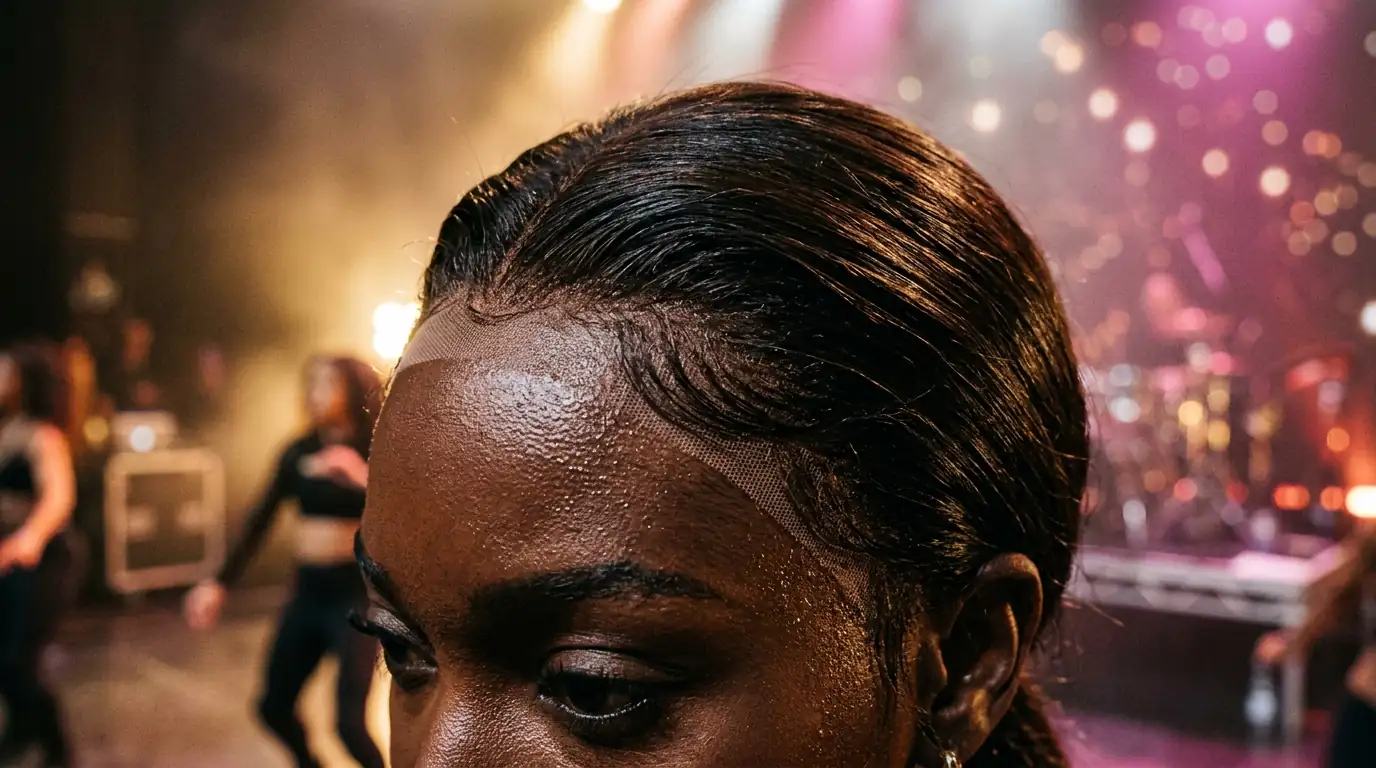
1. The Stadium Stress-Test: Why Everyday Salon Installs Fail on Stage
In a luxury salon environment, a standard lace frontal install is engineered for passive lifestyle demands: climate-controlled offices, social dinners, and gentle slumber on a satin pillowcase. Under these baseline conditions, a standard water-based lace glue will easily hold for two to three weeks.
However, when an entertainer steps onto a stadium stage—such as during Beyoncé’s grueling 56-date Renaissance World Tour or headlining summer festival sets—those tranquil assumptions disintegrate. The physical environment presents four catastrophic destabilizers:
1. Eccrine Gland Volume & Osmotic Saline
The human scalp contains approximately 200–300 eccrine sweat glands per square centimeter. During high-intensity dance routines, cardiac output pushes scalp sweat excretion to upwards of 1.5 liters per hour. As sweat emerges beneath the lace, its sodium chloride content creates osmotic pressure that forces water molecules into the adhesive boundary layer, inducing rapid polymer hydrolysis.
2. Sebaceous Squalene Emulsification
Heat dramatically accelerates sebum production. Sebaceous triglycerides, wax esters, and free fatty acids act as organic lipophilic solvents. While water-based glues can repel pure water, they dissolve rapidly when bathed in heated scalp lipids, turning the bond into a milky, rubbery paste that loses shear resistance.
3. Thermal Softening Point (Glass Transition)
Polymer adhesives have a characteristic Glass Transition Temperature ($T_g$). Standard consumer glues have a low $T_g$ (~35°C to 38°C / 95°F to 100°F). Combined body heat (37.5°C) and overhead stage lighting easily push perimeter skin temperatures above 40°C, causing the adhesive polymer chains to shift from a rigid structural state into a viscous, tacky fluid.
4. Rotational Shear & Inertial Whipping
A typical 24-inch custom performance wig constructed with 250% density weighs between 300 and 450 grams. During head whips and rapid pirouettes, centrifugal acceleration subjects the frontal lace to up to 4G of inertial pull. If the lace perimeter is carrying that load, the bond will delaminate immediately.
To overcome these multi-axial stressors, celebrity hair engineers do not search for a mythical "permanent glue." Instead, they build a multi-tiered mechanical and chemical architecture designed around redundancy, moisture diversion, and load distribution.
2. Adhesive Biochemistry: Water-Based Acrylics vs. Silicone Polymers
Navigating the marketing jargon of lace adhesives requires understanding polymer chemistry. Consumer packaging frequently boasts "medical grade," "super hold," or "waterproof," yet clinical reviews highlight that marketing terms rarely reflect actual monomer compositions (PubMed Central PMC10550043).
Water-Based Acrylic Copolymer Emulsions
The gold standard for performance installations remains high-purity water-based acrylic copolymer emulsions (exemplified by professional formulations such as Ghost Bond Platinum and Bold Hold Active). When dispensed, these products appear as opaque white liquids. The formulation consists of microscopic acrylic polymer spheres suspended in an aqueous carrier.
As the water evaporates, the acrylic spheres undergo coalescence—they pack together, deform, and fuse into an optically clear, continuous polymer film. This cured matrix provides exceptional tensile tack and flexibility. However, its longevity depends entirely on allowing each micro-layer to evaporate completely before applying the next. If a stylist traps unevaporated water beneath a fresh layer, sweat will immediately re-emulsify the core, creating the dreaded "white cloudy ridge."
Silicone-Based Elastomeric Adhesives
Silicone adhesives (such as Walker Tape Liqui-Tape or specialized medical bonding fluids) rely on cross-linked polydimethylsiloxane (PDMS) networks dissolved in ethyl acetate or heptane carriers. Silicone exhibits profound hydrophobic properties—it repels moisture with far greater thermodynamic resistance than acrylics.
However, silicone adhesives present distinct operational trade-offs for high-energy performance: they possess lower initial shear resistance, require extended solvent evaporation times, and can slide under intense friction if the scalp produces heavy sebum. Consequently, tour stylists often deploy a hybrid interface: a silicone skin barrier film directly on the stratum corneum, followed by acrylic copolymer adhesive coats.
Comparison Matrix: Performance Adhesive Chemistries
| Adhesive Class | Key Polymer | Perspiration Defense | Sebum Resistance | Removal Chemistry |
|---|---|---|---|---|
| Acrylic Copolymer | Ethylhexyl Acrylate / Butyl Acrylate | High (if multi-layered & cured) | Moderate (degraded by free fatty acids) | Alcohol or Citrus Hydrocarbon |
| Silicone Elastomer | Polydimethylsiloxane (PDMS) | Extreme (chemically hydrophobic) | Low-Moderate (slips on oil films) | Specialized Silicone Solvents |
| Polyurethane Barrier | PVP / Dimethylaminoethyl Methacrylate | High (seals pores without clogging) | High (blocks sebum egress) | Standard Cleansing Shampoo |
3. Tension Physics: Why the Hairline Must Never Carry the Wig
The most catastrophic mistake in lace wig wear—and the single leading cause of wig-induced traction alopecia in women of African descent—is utilizing the frontal hairline as a load-bearing anchor (PubMed Central PMC5419059).
The hair follicles situated along the frontotemporal perimeter (the "baby hairs" and delicate marginal edges) possess smaller dermal papillae, shallower follicular bulb depths (2.5mm vs. 4.5mm at the vertex), and thinner connective tissue sheaths. They are biologically incapable of resisting sustained tensile pull.
The 3-Point Mechanical Load Distribution Architecture
In professional stage hair engineering, the frontal lace serves an exclusively aesthetic role: it creates the optical illusion of natural follicular emergence from the scalp. It holds zero percent of the wig’s gravitational or centrifugal weight. The load is distributed through three structural zones:
The Occipital Shelf Anchor (Primary Counterweight)
The human skull features a natural anatomical ledge at the external occipital protuberance. Master stylists construct an internal, high-tension 1.5-inch elastic band anchored beneath this ridge. This band locks the wig cap securely into the nape, absorbing 70% of forward gravitational inertia when the performer bends forward or whips their hair.
The Parietal Ridge Cornrows (Lateral Shear Absorbers)
The foundational braid pattern must not pull backwards from the forehead. Instead, stylists braid two anchor cornrows horizontally along the parietal ridge (above the ears). Internal wig combs or micro-stitch anchors attach directly to these dense, high-traction braid anchors, absorbing lateral centrifugal forces during rapid turns.
The Floating Frontal Perimeter (Zero-Tension Melt)
With the cap completely anchored at the crown and occiput, the HD lace rests upon the forehead with neutral tension. When adhesive is applied, it only has to resist minimal peeling forces rather than opposing the entire mass of the hairpiece. This neutral-tension alignment is the secret to hairlines that survive multi-hour shows without lifting.
4. The 7-Step Tour-Grade Melting Protocol
Achieving a stage-proof melt that passes 8K ultra-high-definition camera inspection requires surgical discipline during preparation and chemical curing. Follow this exact 7-step backstage protocol:
Step 1: Non-Stripping Epidermal Degreasing
Do not use 91% or 99% isopropyl alcohol directly on sensitive temporal skin; harsh solvent dehydration causes reactive rebound sebum flooding within 60 minutes. Instead, cleanse the perimeter with an oil-free micellar water followed by a gentle 70% alcohol swipe to lift surface lipids, then pat completely dry.
Step 2: Cross-Linking Scalp Protector Film
Apply a specialized medical barrier film (such as Scalp Protector or Skin-Prep). This creates an invisible, micro-porous polyurethane membrane over the skin. It serves two functions: it blocks sweat and sebum from reaching the adhesive from below, and it prevents acrylic monomer penetration into living epidermal tissue. Allow it to dry until completely non-sticky.
Step 3: The 4-Coat Micro-Layering Technique
Dispense a drop of professional acrylic copolymer adhesive onto a metal spatula. Smooth an ultra-thin, translucent smear across the forehead—half an inch in front of the natural hairline. Crucial Rule: Never apply layer two while layer one is white. Wait 90 to 120 seconds until the layer becomes completely optical glass clear and tacky to the touch. Repeat for four micro-thin layers. Four thin coats create an elastic laminated polymer matrix; one thick coat traps water and fails.
Step 4: HD Swiss Lace Placement with Zero Shear
Use genuine high-definition (HD) Swiss lace featuring a monofilament diameter under 0.06mm. Gently lower the lace onto the tacky fourth layer without stretching. Stretching the lace introduces internal elastic recall tension that causes premature edge lift within hours.
Step 5: The Tail-Comb Pressure Embed
Do not use your fingertips to press lace into glue; skin oils and heat immediately degrade the curing polymer. Use the flat teeth of a carbon-fiber rat-tail comb to press the lace grid downward into the adhesive matrix, forcing the clear polymer to wrap completely around each monofilament thread.
Step 6: High-Compression Elastic Band Cure (The 15-Minute Lock)
Wrap a wide (2.5 to 3-inch) elastic or neoprene melt band firmly over the entire perimeter. Apply gentle blow-dry heat on the cool/warm setting for 5 minutes, then leave the band tightly wrapped for at least 15 minutes. This static mechanical pressure drives out microscopic air pockets and bonds the lace flush to the epidermal stratum corneum.
Step 7: Hydrophobic Matte Powder Seal
After removing the melt band, dust a sheer translucent powder containing silica and hydrophobic zinc stearate directly along the hairline. This neutralizes residual surface tackiness, prevents lint adhesion, and provides a continuous matte finish under stage lighting.
5. Dermatological Health: Preventing Edge Loss, Contact Dermatitis & Microbial Overgrowth
A flawless visual aesthetic is meaningless if it culminates in follicular scarring or chronic dermatitis. Trichologists and dermatologists consistently document three major clinical pathologies associated with aggressive wig wear in textured hair:
Allergic Contact Dermatitis to Acrylate Monomers
Acrylates and methacrylates are well-documented sensitizers. Research published in dermatological literature (PMC10550043) highlights that individuals frequently develop Type IV delayed hypersensitivity reactions after repeated exposures. Early warning signs include intense itching along the hairline, follicular erythema, tiny clear papules, or peeling skin.
If these symptoms appear, continuing to apply adhesive will worsen sensitization. A complete break from adhesives is mandatory, and a board-certified dermatologist should conduct standardized patch testing.
Scalp Occlusion & Microbial Dysbiosis
Wearing a dense stocking cap, multiple layers of adhesive, and a heavy wig for consecutive days creates a warm, moist, occluded microclimate. Clinical studies on textured hair practices (PMC5418894) demonstrate that occlusion shifts the scalp microbiome away from healthy commensal flora toward opportunistic proliferation of Malassezia species and Staphylococcus bacteria, exacerbating seborrheic dermatitis and folliculitis.
The 48-Hour Rest Rule: Never wear a performance-glued install continuously for more than 5 to 7 days without removing the unit, cleansing the scalp with an antifungal, antimicrobial clarifying wash, and allowing the follicles 48 hours of open-air recovery.
Backstage Safety Warning: Cyanoacrylate (Superglue) Prohibition
Some underground styling circles advocate using household cyanoacrylate ("superglue") for emergency hold. This practice is extremely dangerous. Cyanoacrylate polymerizes exothermically, causing severe thermal tissue burns on skin. It forms a brittle, non-porous crystal that permanently tears the epidermal stratum corneum upon removal, stripping hair follicles out by the root and causing irreversible scarring alopecia. Never allow cyanoacrylate near living skin.
Frequently Asked Questions: Tour Wigs & Sweat-Proof Longevity
Can a lace front wig really be 100% sweat-proof?
No cosmetic adhesive bond is completely impervious to human physiology. Rather than stopping perspiration, tour-grade installs manage moisture through multi-layered chemical redundancy: hydrophobic barrier films, water-based acrylic copolymer emulsions that resist eccrine dissolution, and secondary mechanical anchors (elastic nape bands and anchor cornrows) that prevent shear displacement when perspiration softens the perimeter bond.
What is the difference between waterproof and sebum-resistant wig adhesives?
Waterproof refers to an adhesive's capacity to repel external water (humidity, rain, light mist) once fully polymerized. However, human sweat contains sodium chloride, lactic acid, and urea, while sebaceous glands secrete free fatty acids and squalene. Sebum acts as a natural solvent that emulsifies acrylic polymers. An adhesive can be waterproof yet fail completely if it lacks oil-resistant cross-linking polymers.
Why do tight braids increase the risk of traction alopecia under a wig?
When foundational cornrows are braided under high tension, particularly around delicate temporal and frontal margins, sustained mechanical pull triggers subclinical perifollicular erythema. Adding the gravitational and inertial weight of a 250-gram dense human hair wig during rapid head movement amplifies mechanical shear forces on the dermal papilla, causing ischemic atrophy and permanent traction alopecia if worn repeatedly.
What are the dermatological risks of acrylic copolymer and cyanoacrylate glues?
Acrylic copolymer adhesives can induce irritant contact dermatitis or type IV delayed hypersensitivity allergic reactions, manifesting as pruritus, follicular erythema, edema, and micro-vesicles. Furthermore, illicit or accidental use of cyanoacrylate (household superglue) causes chemical thermal burns, severe contact sensitization, and catastrophic hair follicle avulsion upon removal.
How do celebrity stylists secure wigs during high-intensity dancing without edge lifting?
Stylists use a 3-tier hybrid anchor: first, an ultra-flat foundational braid pattern distributing wig weight to the crown and occipital bone; second, a medical-grade skin prep barrier film followed by 3 to 4 micro-thin layers of clear-cured acrylic polymer; and third, an internal adjustable 1.5-inch elastic tension band sewn behind the ears that absorbs forward kinetic inertia, leaving the frontal hairline under zero tension.
What is the safest way to remove a sweat-proof lace install without damaging edges?
Never pull, pry, or force lace off the skin while adhesive remains tacky. Apply an alcohol-free, citrus- or mineral-based solvent directly along the lace perimeter with a micro-applicator. Allow the solvent 3 to 5 minutes to chemically dissolve the polymer matrix until the lace slides away effortlessly without taking delicate infant hairs with it.