Tension-Free Structural Pinning for Type 4 Red Carpet Updos
High-drama red carpet chignons, gravity-defying sculpted buns, and avant-garde crown structures command the Met Gala and awards season stages. Yet beneath that red-carpet polish lies a severe trichological hazard: excessive mechanical tension concentrated on delicate marginal hairlines. Here is how master celebrity stylists build towering architectural updos on Type 4 coily hair while keeping scalp tension near zero.
Core Architectural Principles for Zero-Tension Formal Updos
- 1. Occipital & Parietal Weight Anchoring: Never let frontal or temporal margins bear the physical load of hair pieces. Heavy structural volume must anchor at the occipital shelf where hair density and follicle root depth are greatest.
- 2. Criss-Cross Bobby Pin Friction Physics: Locking two bobby pins at opposing 45-degree angles through a fold creates mechanical grip through geometry, eliminating the need to pull roots taut.
- 3. Internal Mesh Armatures: Lightweight nylon wire mesh and sculpted hair foam donuts bear the visual weight, allowing the client's natural hair to drape softly across the surface without tension.
- 4. Perimeter Preservation Buffer: Always leave a 1.0 to 1.5 cm perimeter border around the frontal hairline completely free from structural pull, styling baby hairs purely as decorative accents.
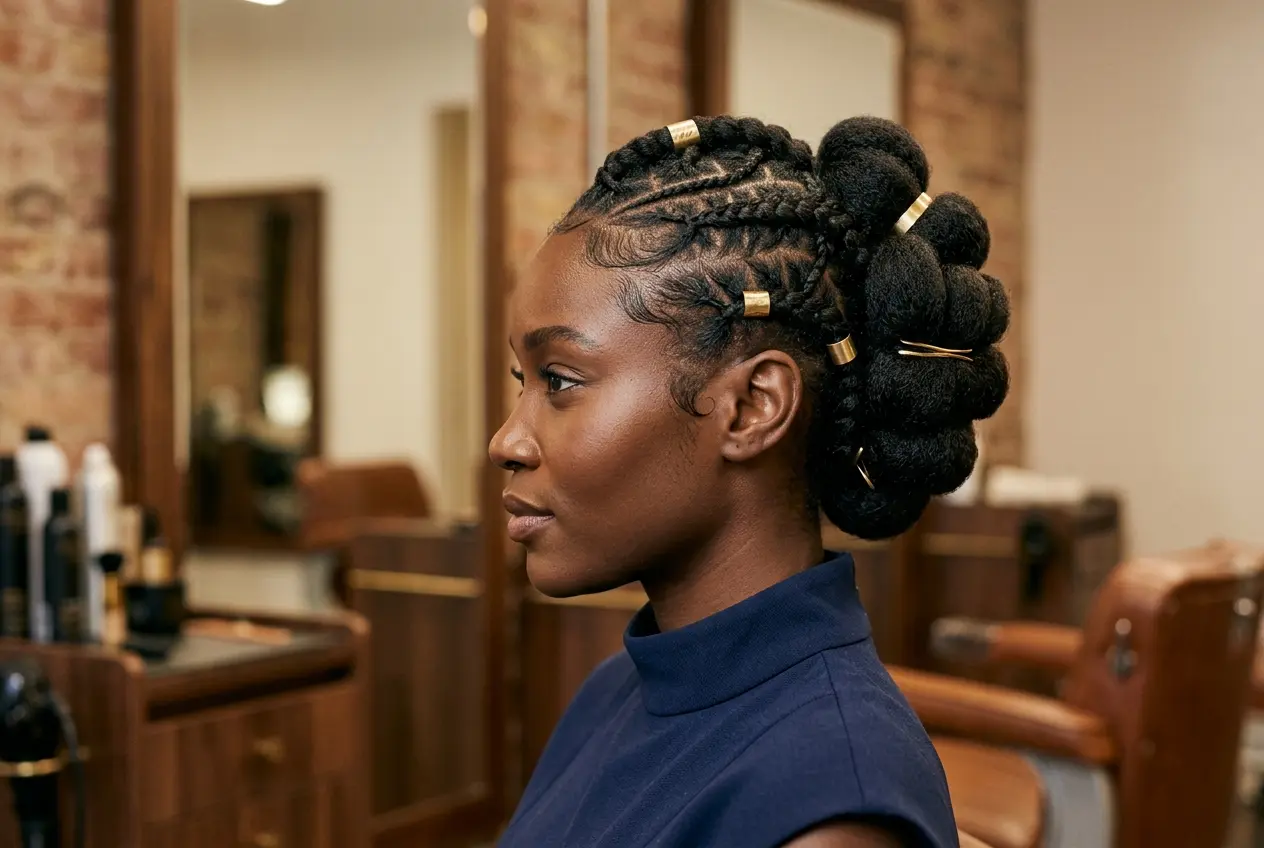
1. The Biomechanics of Red Carpet Strain: Why High-Impact Updos Threaten Marginal Follicles
When an A-list celebrity arrives at a film premiere or gala, their updo must remain razor-sharp for eight to twelve hours under flashing photographer strobe lights, ambient humidity, and swift paparazzi turns. Historically, stylists achieved this immaculate firmness through sheer brute force: slicking the hair back with high-alcohol pomades and cinching the entire density into an ultra-tight, high-tension ponytail secured with non-yielding elastic bands.
For Type 4 hair (specifically tight 4A coils, 4B zig-zags, and 4C kinky coils), this traditional approach is a mechanical disaster. Clinical research in the International Journal of Trichology (Gavazzoni Dias, PMID: 25878443) highlights that afro-textured hair possesses an elliptical cross-section with periodic diameter variations along the fiber. These natural geometric nodes create intrinsic mechanical stress concentrations, making the hair shaft uniquely susceptible to shear breakage when bent sharply against rigid metal pins.
Even more concerning is the follicular anatomy of the scalp's perimeter. As documented by Billero & Miteva in Clinical, Cosmetic and Investigational Dermatology (PMID: 29670386), traction alopecia originates when continuous or repetitive pulling forces exceed the mechanical tensile tolerance of the follicle-dermis attachment. Frontal and temporal hair follicles emerge at acute angles and sit at shallower depths in the scalp than crown follicles (clinical principles detailed in our guide to knotless braids and tension alopecia prevention). Sustained upward shear causes acute ischemia in the micro-vascular capillary bed of the dermal papilla, inducing perifollicular erythema, traction folliculitis, and eventual fibrotic scarring that destroys the hair stem cell niche permanently.
Marginal vs. Crown Follicle Resilience
Occipital and vertex follicles have deep root bulbs (approx. 4.0–4.5 mm) supported by dense reticular dermis, capable of absorbing distributed mass. Marginal temporal follicles sit just 2.5–3.2 mm deep, surrounded by thinner connective tissue, rendering them fragile under forward or upward tension vectors.
The Ischemic Cascading Effect
When hair is pulled tightly for hours, mechanical strain compresses the perifollicular micro-arterioles. The resulting hypoxia triggers cellular distress signals, apoptosis of outer root sheath keratinocytes, and premature transition from active anagen into resting telogen phase.
2. Load-Bearing Geometry: Transferring Weight to the Occipital Ridge
The golden rule of red-carpet architecture at Kayla’s Beauty Supply is simple: the perimeter creates the illusion, but the cranial core carries the load. Much like our kinetic load distribution protocols for tour wig longevity and stage tension physics, rather than pulling the entire head of hair into a single high-stress junction, celebrity stylists divide the head into three distinct mechanical zones:
- Zone 1: The Perimeter Isolation Halo (1.0 to 1.5 cm width): A delicate border encompassing the entire frontal hairline, temples, and nape edges is completely sectioned out before any structural styling begins. This hair is never incorporated into anchor bands or subject to heavy pin torque.
- Zone 2: The Foundation Anchor Core (Crown & Occiput): The central and posterior hair is grouped into broad, flat cornrows or low-tension flat-twists against the occipital bone. Because the occipital shelf sits on a natural structural plane, it safely supports hair extensions, pads, and ornamental pieces without sliding downward.
- Zone 3: The Sculptural Canopy (The Overlay): The remaining mid-lengths are gently curved, folded, and pinned over the anchor core. Because the foundation absorbs the weight, the outer canopy can be pinned with minimal insertion force.
By shifting the center of gravity downward toward the occipital shelf, the mechanical leverage exerted on the client’s neck and scalp drops dramatically. Mayo & Callender in the International Journal of Women's Dermatology (PMID: 33937486; PMCID: PMC8072502) emphasize that reducing the physical weight and mechanical leverage of formal styling is the single most effective intervention against traction damage—a cornerstone of long-term protective styling longevity and scalp integrity.
3. The Physics of Bobby Pin Mechanics: Interlocking Friction vs. Scalp Gouging
Most casual stylists treat bobby pins like metal clamps, prying them open with their teeth and jamming them into tight hair until the metal scrapes the sensitive scalp. In salon reality, this technique strips the cuticle layer, causes gouges in the epidermis, and creates agonizing pressure points that throb by the time the client reaches the red carpet.
Professional structural pinning relies on three immutable mechanical rules:
1. Wavy Side Down (The Friction Grid)
Bobby pins are designed with one wavy prong and one straight prong. The wavy prong must always face inward toward the scalp. The curves act as a mechanical friction trap that holds hair fibers inside each groove, preventing outward slippage without needing to pinch the pin closed.
2. The 45-Degree Opposing X-Lock
A single bobby pin inserted linearly will slide when the performer tilts their head. Instead, master stylists slide the first pin upward through the folded hair section at a 45-degree angle, then slide a second pin at an opposing 45-degree angle so their bodies intersect, forming a scissor-lock ("X"). The pins lock into each other's friction grooves, creating immovable structural support without penetrating the scalp dermis.
3. Never Pry Open With Teeth
Prying a bobby pin wide before insertion bends the metal hinge past its elastic yield point, destroying its clamping tension. Furthermore, metal fatigue can expose sharp zinc edges that slice hair fibers. A quality pin should be glided directly into hair with only a millimeter of fingertip separation.
4. Internal Sculptural Armatures: Mesh Padding & Weightless Volume
When observers marvel at a six-inch-high sculptural updo worn by Lupita Nyong'o or Zendaya, they often assume the entire structure consists of dense human hair extensions packed tightly onto the skull. In truth, packing that much physical hair onto a client's head would introduce 300 to 500 grams of gravitational load—a recipe for severe neck strain and instant follicular avulsion.
Backstage cosmetologists utilize internal armatures fabricated from ultra-fine nylon honeycomb mesh, expanded polyethylene foam forms, or lightweight synthetic crepeline. These armatures weigh under 25 grams.
The stylist anchors the mesh armature directly to the central occipital anchor cornrows using large, U-shaped hairpin anchors. Once the armature is firm, the client’s actual natural hair is gently blown out, smoothed with a lightweight serum containing functional silicones (Gavazzoni Dias et al., PMID: 34984093), and draped lightly over the mesh. Bobby pins are then pushed into the mesh filling rather than into the client’s hair roots. The mesh acts as a pincushion, holding the sculptural silhouette rigidly in place while the client's follicles experience zero tension.
5. The Perimeter Edge Strategy: Styling Delicate Margins Without Traction
Baby hairs and temporal margins are the crowning glory of a finished red carpet look, but they are also the most vulnerable to permanent destruction. Classic high-alcohol edge controls dry into brittle crystalline sheets that cement fine hairs to the skin. When the client smiles, talks, or moves their facial muscles, the rigid dried edge control pulls on the follicular mouth, causing mechanical traction folliculitis.
Master stylists in South Florida follow a three-step perimeter preservation routine:
- Lipid-Infused Water-Soluble Gels: Stylists choose water-based pomades enriched with panthenol, aloe vera, and squalene rather than high-alcohol or drying polyvinylpyrrolidone (PVP) formulas. The lipid content ensures the hair retains flexibility during facial expressions.
- Micro-Bristle Soft Sculpting: Never use stiff toothbrush bristles that can abrade the delicate scalp epidermis. Use an ultra-soft natural boar-bristle brush, sculpting sweeping curves along the natural growth direction of each hair cluster rather than forcing them backward against their follicles.
- Low-Compression Satin Setting: Once sculpted, tie a pure mulberry silk wrap lightly across the perimeter for just 5 to 7 minutes to set the shape. Never leave tight compression bands on for hours, which can cause ischemic hairline ring marks.
6. The Post-Gala Release Protocol: Safe Pin Extraction
Breakage rarely happens when the updo is styled—it happens at 2:00 AM when an exhausted client attempts to yank 40 bobby pins out of their hair in the hotel bathroom. Over an evening of wear, hairspray resins, humidity, and natural sebum dry into an adhesive lattice around the metal pins. Yanking pins straight out strips cuticle shingles and snaps fragile Type 4 coils at the root.
Kayla’s 3-Step De-Pinning Protocol
- Step 1: The Botanical Mist Release: Spray a light mist of warm water and jojoba or argan oil over the updo. Allow 2 minutes for the lipid mist to soften rigid hairspray polymers.
- Step 2: Gentle Tine Separation: Locate each pin head with your fingertips. Gently widen the two metal tines by a fraction of a millimeter to release its friction grip before sliding it outward along the grain of the hair.
- Step 3: Scalp Recovery Oxygenation Massage: After removing all armatures, use the pads of your fingertips (never fingernails) to perform a 3-minute circular scalp massage. This stimulates immediate blood flow to any capillaries compressed during the event, replenishing vital oxygen and nutrients to the dermal papillae.
Trichological Literature & Peer-Reviewed Evidence
- International Journal of Women's Dermatology: Mayo TT, Callender VD. The art of prevention: It's too tight—Loosen up and let your hair down. Int J Womens Dermatol. 2021;7(2):174–179. PMID: 33937486; PMCID: PMC8072502.
- Clinical, Cosmetic and Investigational Dermatology: Billero V, Miteva M. Traction alopecia: the root of the problem. Clin Cosmet Investig Dermatol. 2018;11:149–159. PMID: 29670386; PMCID: PMC5896661.
- International Journal of Trichology: Gavazzoni Dias MF. Hair cosmetics: an overview. Int J Trichology. 2015;7(1):2–15. PMID: 25878443; PMCID: PMC4387693.
- Indian Journal of Plastic Surgery: Gavazzoni Dias MF, Loures AF, Ekelem C. Hair Cosmetics for the Hair Loss Patient. Indian J Plast Surg. 2021;54(4):507–513. PMID: 34984093; PMCID: PMC8719955.
- International Journal of Women's Dermatology: Humphrey JG, Harding MJ, Cartwright KM, Thomas LE, Luke J. Afro-textured hair care: a narrative review and recommendations for clinical practice. Int J Womens Dermatol. 2026;12(1):e2026. PMCID: PMC12900221.
Frequently Asked Questions: Red Carpet Styling Safety
Can an architectural updo cause traction alopecia after a single evening? ↓
A single evening of wear rarely causes permanent scarring alopecia, but severe acute traction can trigger immediate traction folliculitis, localized perifollicular erythema, and mechanical hair fiber snapping. If the updo exerts persistent tension that causes scalp tenderness, headaches, or raised bumps, removing the pins immediately prevents the micro-vascular ischemia that eventually leads to permanent follicle miniaturization.
Which side of the bobby pin should face the scalp during an updo? ↓
The wavy (crinkled) side of the bobby pin must always face downward toward the scalp, while the flat, smooth side faces outward. The undulations in the metal are engineered to grip hair fiber clusters and distribute frictional resistance evenly across the base, preventing the pin from slipping without requiring extreme mechanical clamping force against the scalp.
How do celebrity stylists add massive volume without weighing down natural roots? ↓
Top red-carpet stylists use internal architectural armatures, including ultralight nylon hair padding, mesh hair donuts, and honeycomb cage formers. The natural hair is gently smoothed over the armature rather than packed densely into high-tension ponytails. Bobby pins are anchored into the fibrous mesh foundation itself rather than pulling against the client's hair follicles.
What is the safest way to remove bobby pins after a gala without tearing Type 4 coils? ↓
Never pull or yank bobby pins straight out of an updo, as hairspray resins bond coils to the metal edges, causing mechanical cuticle stripping and breakage. Mist the hair lightly with an alcohol-free detangling oil or leave-in conditioner along the pin entry points, spread the pin tines gently with your fingers, and slide each pin out along the natural grain of the hair shaft.
Why are temporal and marginal hairlines more susceptible to tension damage than the crown? ↓
Hair follicles along the frontal hairline and temporal margins have shallower dermal insertion depths (often 2.5 to 3.5 mm compared to 4.5 mm at the occiput) and a higher percentage of miniaturized or intermediate vellus hairs. Additionally, marginal follicles emerge at acute elliptical angles, making their dermal papillae far more vulnerable to shear displacement under directional pulling forces.