Raw Burmese vs. Vietnamese Raw Hair Bundles: Cuticle Integrity, Grade Myths & Texture Matching
In the $10 billion hair extensions market, consumers are bombarded with deceptive marketing jargon—from arbitrary "12A grade" labels to chemical-laden "mink Brazilian" bundles that matte after four washes. For protective styling wearers investing in multi-year sew-ins and custom wig units, the authentic raw hair sector offers unmatched longevity. Here is the unvarnished truth comparing raw Burmese and Vietnamese hair from a beauty supply director's workbench.
Core Procurement Takeaways
- 1. The Grading Myth: "10A, 12A, or 14A" labels have zero clinical or legal meaning. Genuine single-donor raw hair is categorized solely by donor source, cuticle alignment, and zero chemical processing.
- 2. Raw Burmese Superiority for Type 4 Blends: With a natural coarse-to-medium strand diameter and realistic low-to-medium matte luster, Burmese raw hair effortlessly mimics silk-pressed or blown-out afro-textured leave-out.
- 3. Vietnamese Bleaching Power: Thanks to exceptionally thick, intact cuticle armor, single-donor raw Vietnamese hair can be lightened to #613 platinum blonde without structural disintegration.
- 4. Longevity Equation: Acid-bathed processed bundles degrade within 3 to 6 months; authentic raw bundles deliver 3 to 5+ years of continuous re-installations, dramatically reducing annual protective styling expenditure.
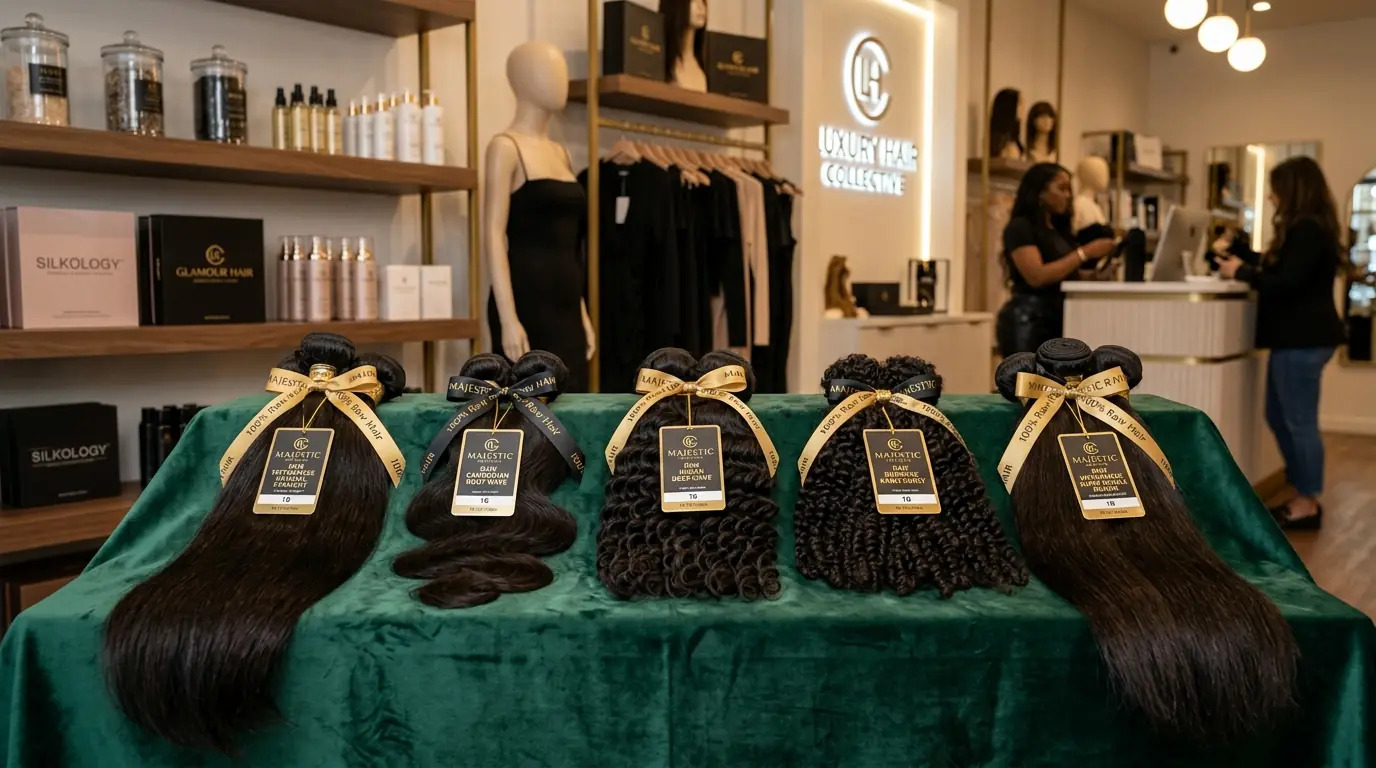
1. Demystifying the Grading Con: Why 10A and 12A Are Meaningless
If you walk into a generic beauty supply store or browse online marketplaces, you will see bundle packaging emblazoned with gold stickers proclaiming "10A," "12A," or even "15A Mink Brazilian Hair."
As licensed cosmetologists and supply directors, we must deliver the hard truth: hair grading numbers are completely fictional.
In the early 2010s, Chinese hair manufacturing exporters introduced "5A" to designate hair that had fewer short filler strands. When competing factories copied the term, others began stamping "6A," "7A," and "8A" on their bags without changing the hair quality. Today, the scale has escalated into absurd marketing numbers. There is no international standardization organization, no regulatory body, and no independent laboratory testing verifying these grades.
The Real Classification Hierarchy: In legitimate wholesale procurement, extensions are classified into three actual biological tiers: Synthetic Blends, Processed Remi / Virgin Hair (acid-bathed and silicone-coated), and True Raw Hair (single-donor or 2-donor, cuticle-intact, completely chemical-free).
2. Raw Burmese Hair: The Ultimate Match for Pressed Type 4 Textures
Sourced from Buddhist temple donations and rural communities in Myanmar (formerly Burma), raw Burmese hair is internationally recognized for its distinctive tactile qualities.
Fiber Anatomy & Low Luster
Unlike mass-market hair that is unnaturally slick and shiny, raw Burmese hair features:
- Medium to Coarse Strand Diameter: Each individual hair shaft is substantially thicker than Caucasian or European hair, exhibiting tactile tooth and texture.
- Low-to-Medium Natural Luster: The hair reflects light with a subtle, realistic sheen rather than a reflective plastic shine. This makes it blend seamlessly with Type 4 natural hair that has been blown out or silk-pressed.
- Natural Organic Waves & Curls: Because the hair has never undergone chemical perm processing or high-pressure autoclave steaming, its natural wave and curly patterns retain remarkable memory, bouncing back immediately after washing.
3. Raw Vietnamese Hair: The Heavy-Density Powerhouse for Platinum Color
Directly harvested from women in the northern mountainous regions of Vietnam, raw Vietnamese hair has become the gold standard for high-end custom wig construction and bone-straight installs.
Cuticle Armor & Structural Purity
Vietnamese women traditionally maintain their hair using herbal concoctions of locust fruit (Gleditsia australis) and holy basil, leaving the cuticles pristine and untouched by harsh dyes or chemical perms:
- Naturally Bone-Straight: Unlike other origins that require high-heat iron pressing to achieve straightness, raw Vietnamese hair grows naturally straight or in gentle ripples, holding a razor-sharp sleek line effortlessly.
- Thick, Intact Cuticle Scales: Under scanning electron microscopy, Vietnamese hair displays 8 to 10 overlapping cuticle layers with dense intercellular cement. This thick structural sheath protects the inner keratin cortex during chemical services.
- The Platinum #613 Benchmark: Because the cuticles are 100% aligned and the cortex is undamaged, single-donor raw Vietnamese hair can withstand the rigorous lifting process required to reach Level 10 platinum blonde without cortical melting or excessive shedding.
When pairing these bundles with lace closures or frontals, review our comparative analysis in HD Lace vs. Transparent Lace for Virgin Wigs.
4. Head-to-Head Architectural Comparison: Burmese vs. Vietnamese
Use this clinical specification matrix to select the ideal raw hair origin for your protective styling needs:
| Physical Attribute | Raw Burmese Bundles | Raw Vietnamese Bundles | Commercial "Virgin" Hair |
|---|---|---|---|
| Fiber Diameter | Coarse to Medium | Medium to Thick | Fine / Thin (Acid Stripped) |
| Natural Luster | Low to Medium (Matte) | Medium to High (Gloss) | Synthetic High (Silicone) |
| Primary Textures | Natural Curly, Deep Wave, Kinky | Bone-Straight, Soft Body Wave | Steam-Pressed Patterns |
| Type 4 Blending | Exceptional (98% match) | Moderate (Requires Flat-Iron) | Poor (Obvious Demarcation) |
| Bleaching Capacity | Up to Level 9 (Honey Blonde) | Up to Level 10 (#613 Platinum) | Snaps past Level 7 |
| Realistic Lifespan | 3 to 5 Years | 3 to 5+ Years | 3 to 6 Months |
5. The Salon Verification Battery: 3 Tests to Detect Fake Raw Hair
Before sewing bundles into your foundation braids, perform these three physical chemistry verification tests used by Kayla's Beauty Supply inspectors:
Isolate a single hair strand from the bundle. Pinch the strand between your thumb and index finger and glide downwards from root to tip. It should feel completely smooth. Now, reverse direction and glide upwards from tip to root. In genuine raw hair, you will feel distinct physical resistance and hear a faint squeaking sound—these are intact cuticle scales catching against your skin. If the strand feels equally slick in both directions, the cuticles have been burned off in an acid bath.
Commercial suppliers coat poor-quality hair in dimethicone silicones to mimic raw luster. Saturate a cotton ball with 100% pure acetone and vigorously wipe a small 1-inch section of the weft. If the hair is coated in chemical sealants, the acetone will strip the silicone within 30 seconds, revealing dull, rough, frizzy, tangled hair underneath. True raw hair will remain soft, flexible, and completely unaffected by acetone.
Snip 4 to 5 strands from the bundle end and expose them to an open flame over a heat-proof dish. Authentic human hair is pure alpha-keratin: it burns slowly, produces white smoke, smells strongly like burnt feathers (sulfur release), and crumbles completely into a fine black ash. Synthetic fibers or synthetic-doped blends melt instantaneously into a black, sticky, hard plastic bead with a pungent chemical petroleum odor.
To learn how proper protective braid foundations safeguard your natural scalp while wearing raw hair installs, explore Protective Styling Longevity & Scalp Integrity. For natural porosity management, check Low Porosity vs. High Porosity Cuticle Science.
Frequently Asked Questions: Raw Hair Extensions
What is the difference between raw hair and virgin hair?
Authentic raw hair is 100% unprocessed human hair cut directly from a single donor's ponytail with all cuticles intact and running in one direction, without any chemical baths, steam-texturizing, or silicone coatings. Commercial 'virgin' hair is frequently sourced from hairbrush floor collectors (multi-donor), bathed in acid to burn off mismatched cuticles, and coated in synthetic silicone gloss that washes away in a few shampoos.
Which raw hair texture blends best with natural Type 4 hair?
Raw Burmese hair is the undisputed champion for blending with Type 4 natural hair. Its strands have a medium-to-coarse cross-section, low-to-medium matte luster, and natural body that mimics the density and texture of blown-out or silk-pressed coily hair without looking unrealistically shiny or synthetic.
Can Vietnamese raw hair be bleached to #613 blonde safely?
Yes. Genuine single-donor Vietnamese raw hair possesses exceptionally thick, robust cuticle walls and high cortex density. When processed by a skilled colorist using low-volume developer in multiple stages, it can safely lift to #613 platinum blonde without melting, snapping, or losing structural elasticity.
Do hair grades like 10A, 12A, or 15A actually mean anything?
No. The numerical grading system (8A, 10A, 12A) is an arbitrary marketing invention created by mass-market export vendors without any regulatory standardization or chemical testing oversight. Reputable wholesale raw hair suppliers do not use number grades; they classify extensions strictly by donor origin (single donor vs multi-donor) and processing integrity.